How to make a simple wading staff
by John Gray
Until this year, I had never used a
wading stick. Apart from the very occasional lapse of concentration,
resulting in an unscheduled, and never life threatening, ducking, I have
managed to keep my feet fairly well over forty years of loch and river
fishing. In general, for loch and river trout fishing, and for night
time sea trout fishing, I would find a wading stick an unnecessary
encumbrance, and I have never felt a pressing need for a third leg in
such fishing. In recent seasons, though, an increasing number of outings
on medium and large salmon rivers, such as the Spey, Teith and Earn,
combined with the lack of agility which comes with the slow but steady
advance in years, has convinced me of the wisdom in taking a bit more
care in potentially risky situations.
Wherever possible, I find much more
satisfaction in using tackle I have made rather than bought .... rods,
flies, spinners, priests etc. So, in the early Spring, before the
fishing season got properly underway, I went in search of a stout stick.
I must say that I found the search itself most enjoyable, a bit like
searching through a second hand bookshop for a hidden gem, with the
added benefit of a good bit of much needed exercise thrown in. Having
cut several likely looking sticks of various kinds from a number of
locations, including ash and willow, I finally settled on a nice length
of hazel. Hazel sticks could almost have evolved for use as wading or
walking sticks. They have a smooth and attractive bark, grow straighter
than most other trees, with a gradual taper and a minimum of side
shoots. Ideally, when cut, a stick should be sealed at both ends to
prevent cracking and stored in a dry place for six months or so before
working on it. Being rather impatient, and in need of a stick for the
imminent fishing season, I left the stick for only a few weeks before
starting on it and I must say that I can detect no fault in the
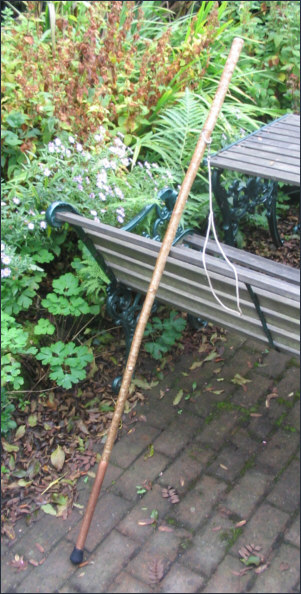
resulting wading stick, which is shown in the photographs below.
The stick is 54 inches in length, loaded
with about 12 ounces of lead contained within a length of 22 mm copper
pipe, while the foot is a rubber rod butt cap, all held together with
silicone sealant. The short detachable cord is looped to the ring on my
wading jacket or waistcoat. I have found the simple flat top on the
handle useful for leaning on, rather than a v-shaped thumb grip.
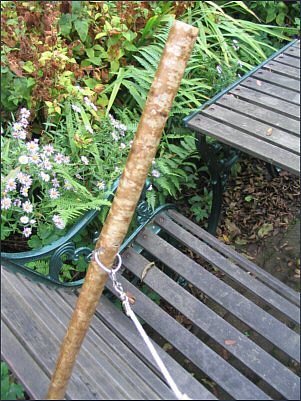
The Wading stick handle and lanyard
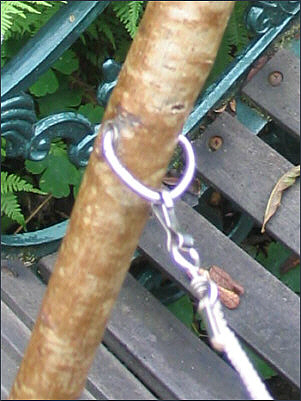
Metal ring and lanyard clip |
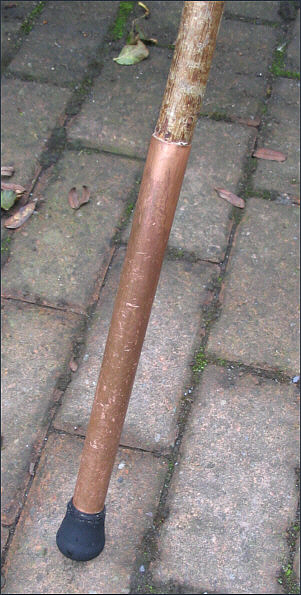
Weighted copper tube and rubber foot
|
|