Hook Choice for Salmon Flies
by John Gray
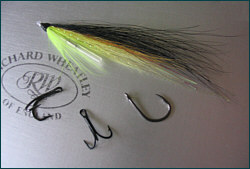
Trout
flies, by
and large, have traditionally been dressed on single fly hooks,
commonly up-eyed hooks for dry fly fishing and down-eyed for wet
flies. Fly hooks have come in various shapes, sizes and weights
.... Limerick bend, Sproat bend, Captain Hamilton, Model
Perfect, to mention only a few of the traditional styles.
Today, fly tyers have a very wide range of hooks from which to
choose, each designed to suit a particular style of fly,
imitative pattern or application. The hook bend may be wide or
narrow, of fine, medium or heavy wire. The hook point on such
fly hooks may be either straight or offset. In theory, the
offset bend offers more efficient hooking potential but, in
practice, most single fly hooks, regardless of design, will work
very well and hook trout efficiently. With the exception of wee
doubles, once popular on Scottish lochs, trout flies are rarely
dressed on anything other than single hooks.Sea Trout Fly Hooks
Fly
hook choice for migratory species such as sea trout and salmon
is not quite so straightforward. In sea trout fishing, single
hooks are still used extensively, both for daytime and night
fishing, and very effective they are, too, but many sea trout
fishers favour double hooks or treble hooks, used either as
dressed flies or, more often, attached to one of a whole variety
of specialist night fishing lures such as snakes,
needle flies, Waddington lures or tube flies. For sea trout,
I like to keep things as simple as possible. I generally only
fish for sea trout at night. Flies for night fishing can range
from flies dressed on singles as small as size 16 to long fish
imitating lures of up to six inches. I, however, rarely use
anything smaller than a size 10 single or longer than two and a
half inches, the longer lures usually simply and sparsely
dressed on a needle or tube, armed with a small double or treble
hook. For flies up to about an inch long, I tend to use single
hooks. My favourite hooks are Partridge Captain Hamilton in size
8 and Partridge Saltwater Perfect, also in size 8. The Captain
Hamilton is a down eyed hook. The Saltwater Perfect hook has a
straight eye, which is perfectly fine for fly tying. I tend to
turn the eye down slightly before use. There may be no
scientific logic in this whatsoever but I have the impression
that the knot is less likely to slip to the side when fishing,
and the fly lie at an angle, if the eye is turned down. I
wouldn't worry too much, though, whether a fly hook has a
straight eye, down eye or upturned eye. One benefit of an up
turned eye, on a salmon hook in particular, is that it
facilitates the tying of the popular Turle knot, which helps the
fly lie straight in line with the leader. The Saltwater Perfect
hook is a well made hook, slightly longer in the shank than a
standard hook and with a nice silvery black nickel finish. With
no body dressing, it makes for very simply dressed, fish
imitating flies.
Like many sea trout fishermen, I also like
tube flies for night
fishing. Flies for sea trout can be dressed on all kinds of
tubes, home made or otherwise, in plastic, aluminium, brass,
copper, steel etc.,
allowing us to make tubes of all shapes, sizes and weights each
for a different purpose and for fishing on or near the surface,
often in the early part of the night, or near the river bed,
usually later in the night, although there are no hard and fast
rules and practices will vary greatly from one river to another
and from one part of the country to another.
As sea trout cannot
distinguish colours at night any more than we can, we need not
worry too much about the colour of our sea trout night flies,
except for their tonal qualities. Different colours will be seen
as varying shades of grey. It might be reasonably argued that a
simple black fly, dressed on a silver hook or tube, will be as
effective as anything for sea trout at night. My favourite sea
trout lures are now dressed very simply, in a variety of
lengths, on
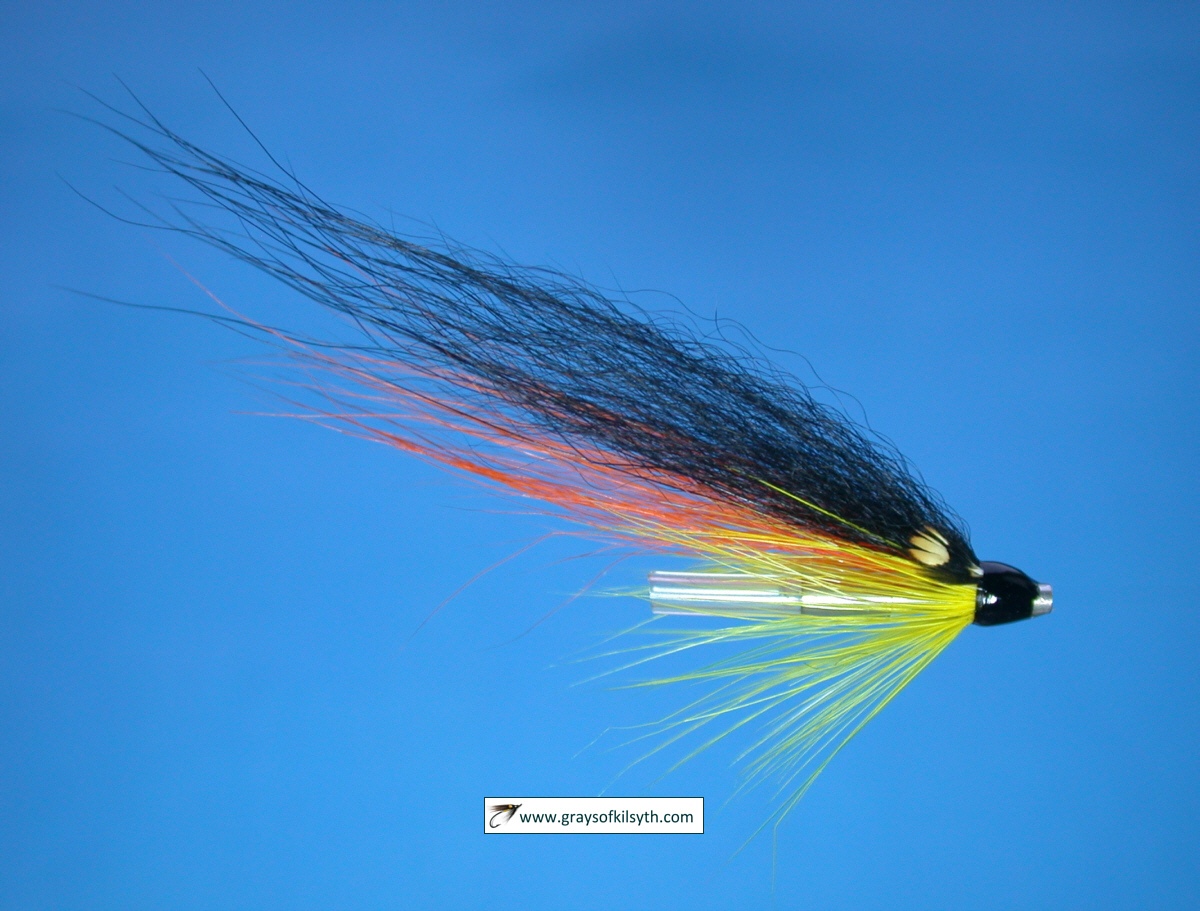
Needle Tubes, ultra slim stainless steel tubes with an
outside diameter of only 1.5 mm.
Being made
from polished stainless steel, the kind used in the making of
hypodermic needles, needle tube flies sink more readily than
aluminium tube flies but fish a little higher, and more
attractively, than the heavier copper and brass tubes. Needle
Tube Flies would have a comparable sink rate and similar slim
profile to flies dressed previously on Waddington shanks, but
with the important benefit that the hook is easily changed on
the needle tube fly. Needle tubes are also much easier to dress
than Waddington or snake lures.
Salmon
Fly Hooks
Salmon fly fishing is
associated with yet another range of specialist flies and fly
hooks. For a long time, throughout the nineteenth century and
most of the twentieth century, single hooks were the
popular
choice for salmon flies. The art of the salmon fly dresser
reached its height in the Victorian era, when the earlier rather
drab Scottish fly patterns of William Scrope (e.g. Meg in her
Braws, Kinmont Willie) were supplanted by a flood of highly
complex and exotic creations (Jock Scott, Silver Doctor, Dusty
Miller, Mar Lodge), some dressed on very large hooks for fishing
the high and cold waters of early Spring. The popularity of
these gaudy patterns continued into the twentieth century when
they were gradually modified, simplified and supplemented by
simpler salmon flies. First the low water style of fly dressing
was applied to earlier patterns (Logie, Jeannie, Blue Charm).
Then, particularly from the 1950's, began the development of the
modern hairwing salmon fly (Hairy Mary, Garry, Stoat's Tail,
Munro's Killer), which we know so well today. Double and treble
fly hooks are now favoured by many salmon fly fishermen, in
preference to the traditional single hooked patterns. In recent
years, there have been many developments in
salmon fly design,
largely based
on
the use of tubes of different shapes, sizes and materials.
Because the
use of tubes allows the hook - single, double or
treble, barbed or barbless - to be changed when required or when
damaged, this adds greatly to the versatility and durability of
a salmon or sea trout fly. Most of my salmon flies are now
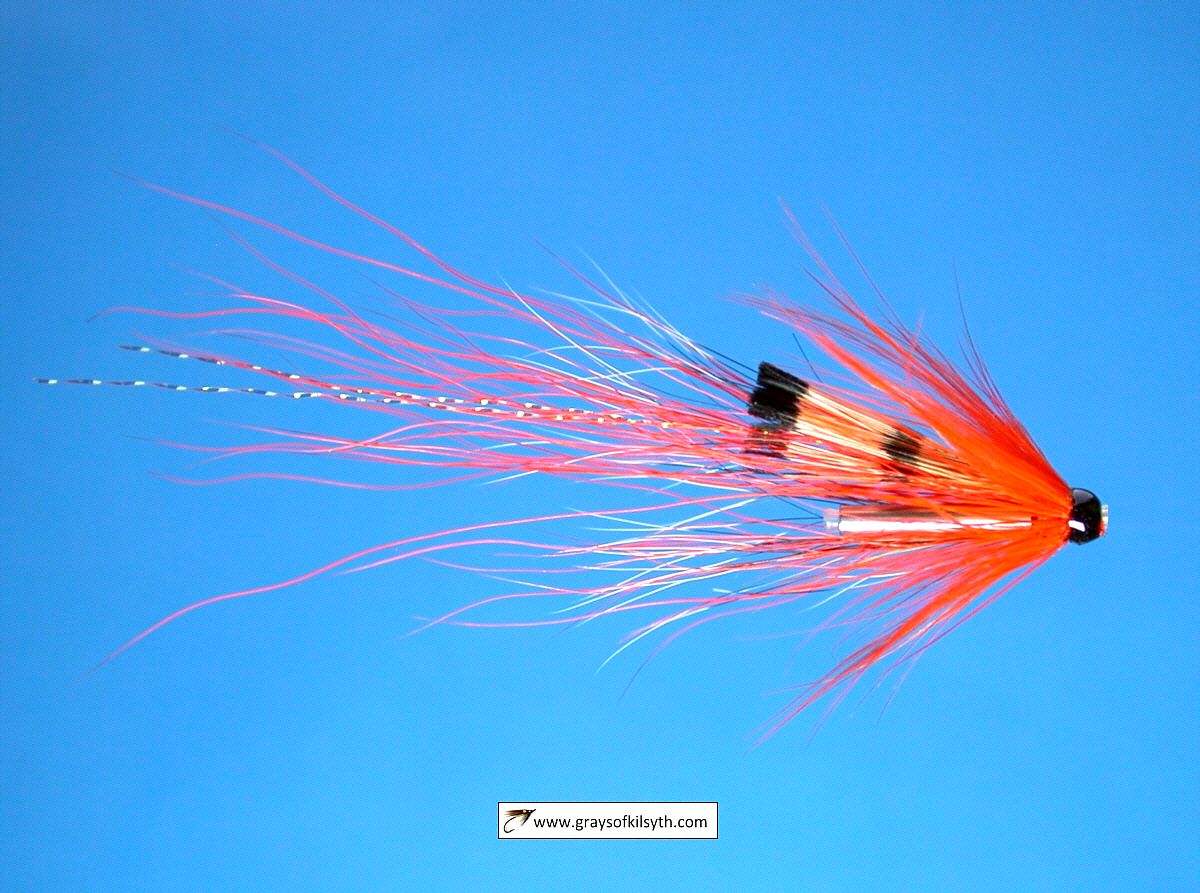
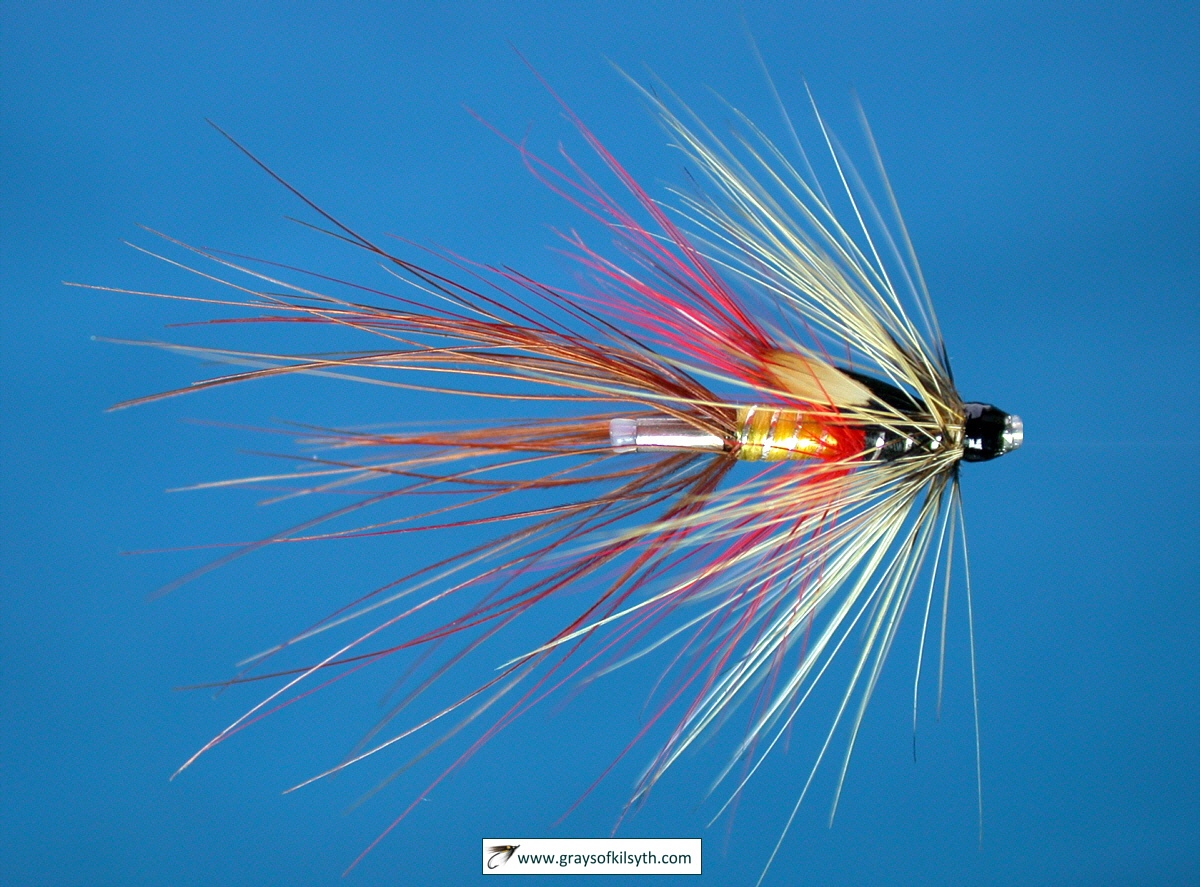
dressed, in varying lengths, on fine stainless steel
needle tubes, creating a fly with a similar weight and
profile to a fly dressed on low water double, but much more
durable, as the hook can easily be replaced when damaged.
See also
Tube Flies
Salmon Tube Fly Hooks
Salmon Tube Flies
can be used with single, double or treble hooks. Indeed, a
variety of hooks are now sold, by companies such as Loop,
Partridge, Fulling Mill and Ken Sawada, specifically for use
with tube flies.
If using a well made treble hook, with all arms of the treble of
equal weight, the positioning of the treble will make no
difference to the way the fly swims. The treble hook will be in
a state of balance, and equally stable, no matter how the arms
of the hook lie and will have no natural tendency to rotate to
reach a particular position. A treble hook, either dressed or
attached to a tube fly, will swim naturally with
the bulkiest/most buoyant materials on top.
The attachment of single and double hooks will be more
influential in determining the way the fly swims. An undressed
single or double hook will, as a rule, tend to swim naturally,
and will be most stable,
with hook points up. So, when attaching a single or double hook
to the rear of a tube fly, it would be advisable to connect it
with the hook points uppermost, i.e. hook points towards the
bulkiest, most buoyant side of the tube. This will add to the
stability of the tube fly, reducing any tendency for the fly to
swim upside down or on its side. Other benefits of setting the
double or single hook with the points uppermost are a) the hair
wing cannot become caught up on the underside of the fly and b)
in the Autumn, the hair wing acts to an extent as a weed guard,
reducing the likelihood of leaves being hooked while fishing.
The above observations apply equally to flies dressed on single
or double hooks. Since undressed single and double hooks tend to
swim naturally with hook points upward, a fly tied with the bulk
of the dressing (the wing) applied on the hook-point side will
be more stable when fishing, with less tendency to swim upside
down
(which in this case would involve the fly swimming with hooks,
and wing, facing downward)
or on its side. (see also
Upside Down Flies)
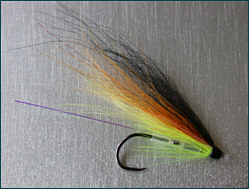
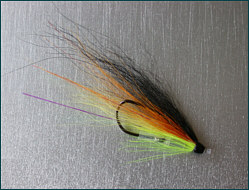
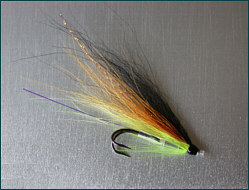
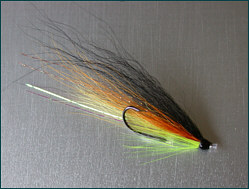
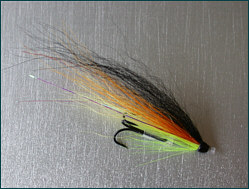
The various possibilities
- a salmon fly dressed on a slim needle tube, fitted with
single, double and treble hooks - are illustrated below ....
 |
 |
|
single hook - point
down (unstable) |
single hook - point up
(stable) |
| |
|
 |
 |
|
double hook - points
down (unstable) |
double hook - points up
(stable) |
| |
|
 |
|
Undressed
single or double hooks will tend to swim with
hook points uppermost. If connected in this way
to tube flies, with the hook points on the side
with the greatest bulk/ most buoyant materials,
then the fly will be more stable while fishing,
with less tendency to swim upside down or on its
side. Also, with the hook points uppermost, the
hair wing cannot get caught up on the underside
of the tube, as it can with hook points down.
See also
Salmon Fly
Selections |
|
|
treble hook |
|
|
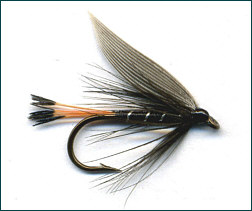
Trout Wet Fly
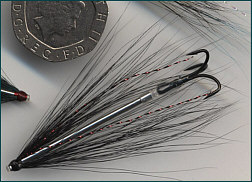
Sea Trout Needle Tube Fly
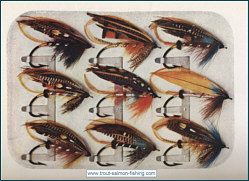
Traditional Salmon Flies
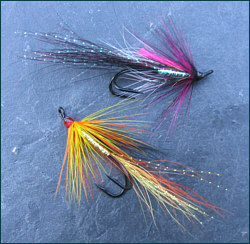
Modern Salmon Fly Doubles
See also
How to make a knot guard (or swing tube) for a Free Swinging Tube
Fly Hook
|
|