Upside Down Salmon Flies
Have we been tying our
trout and salmon flies upside down?
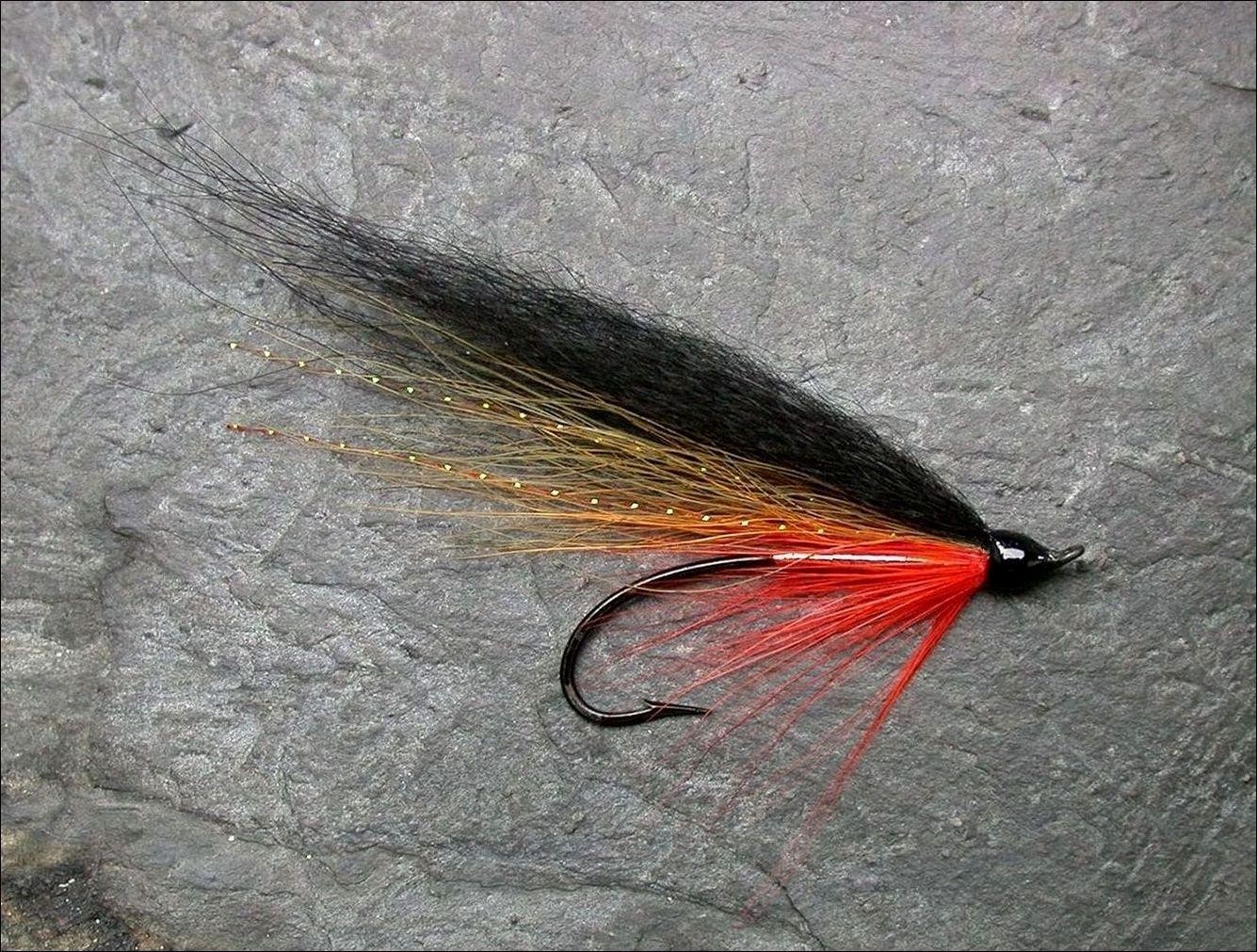
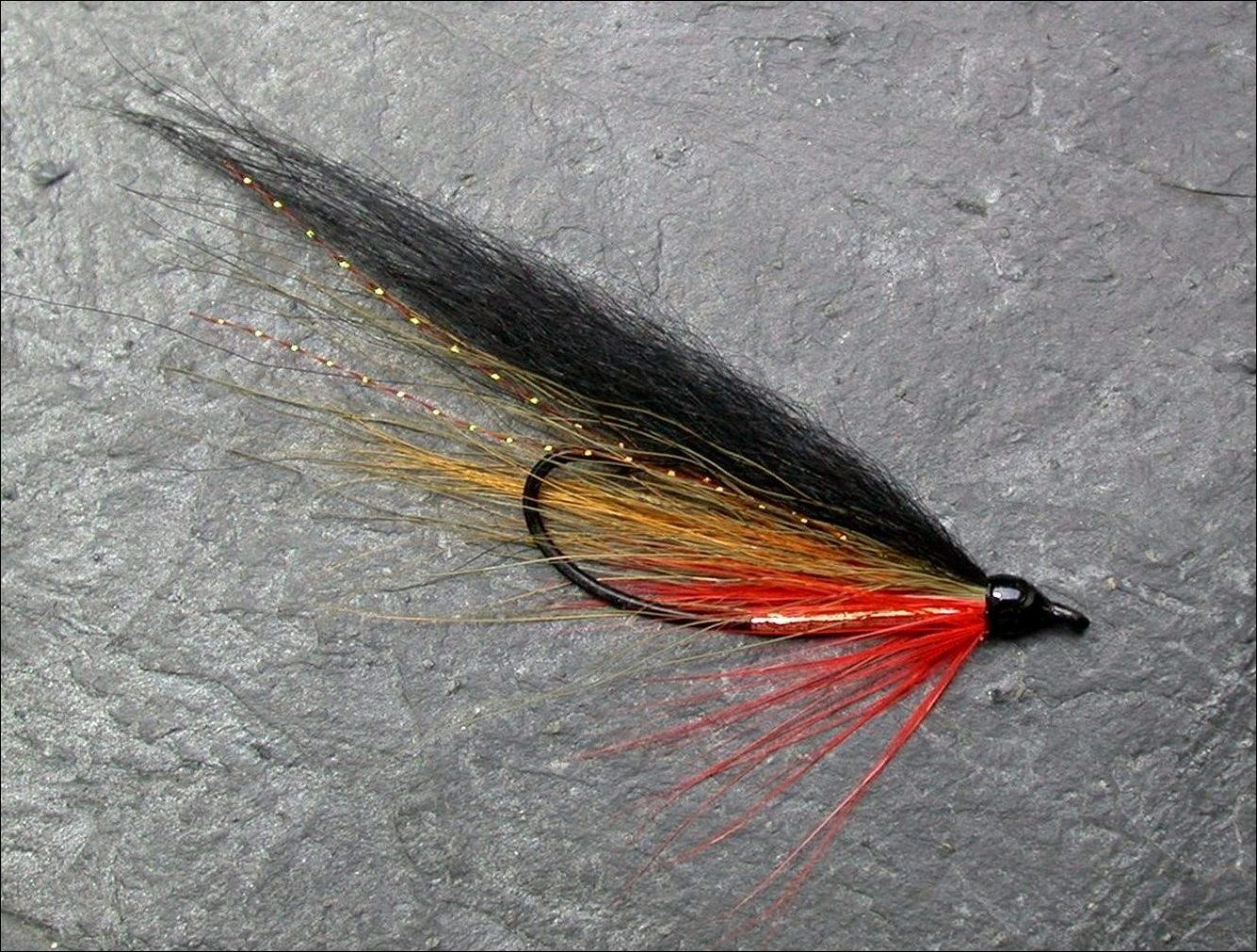
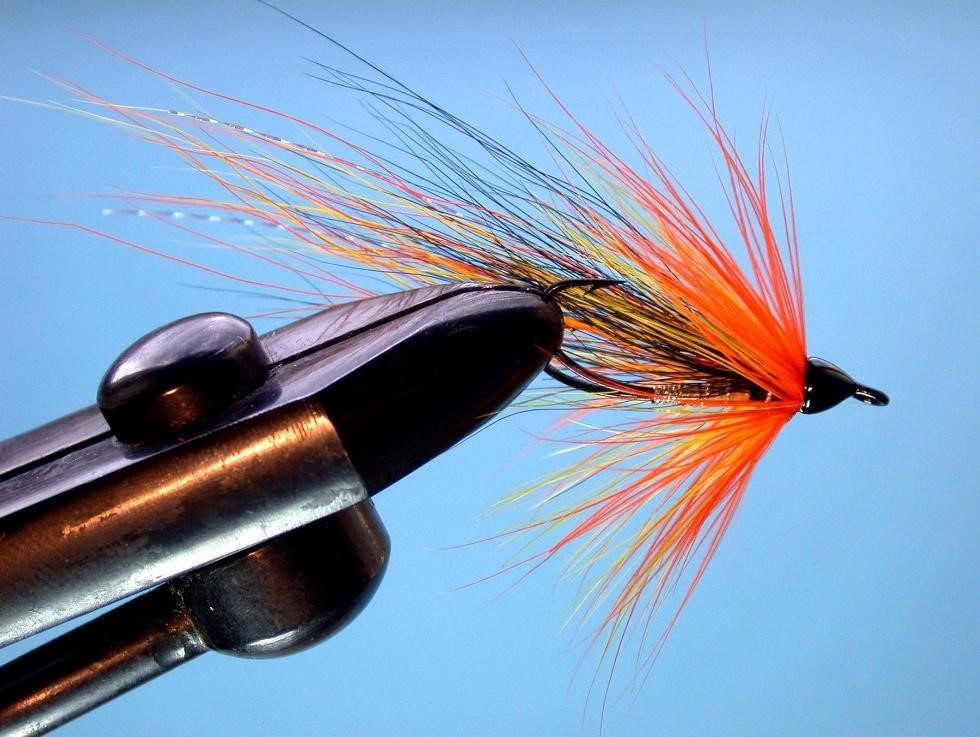
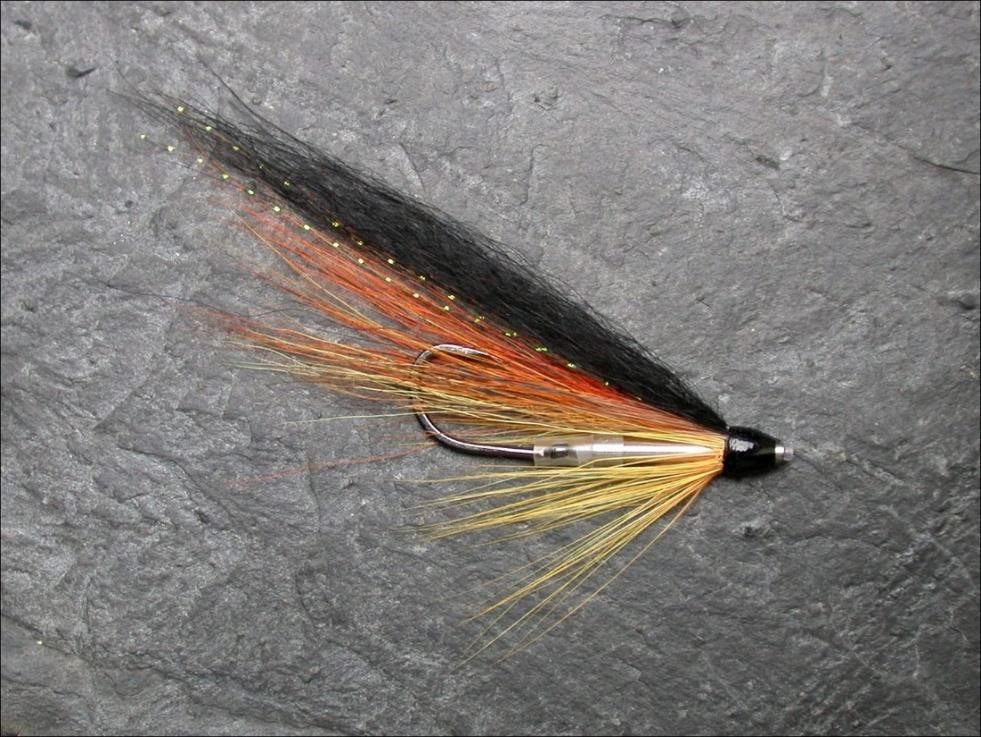
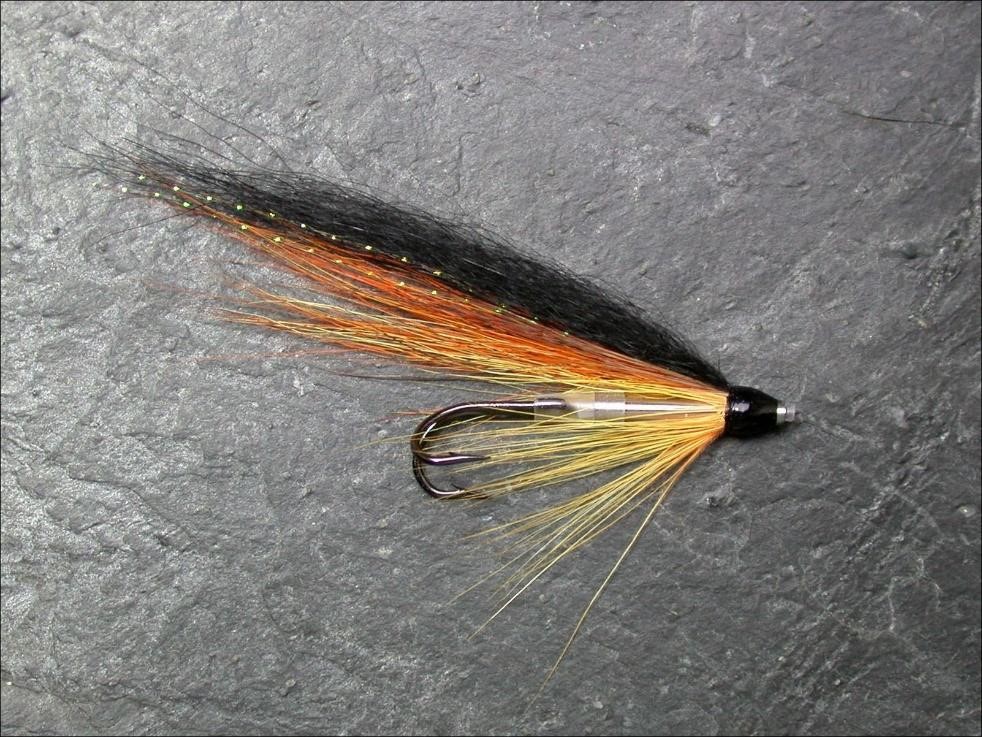
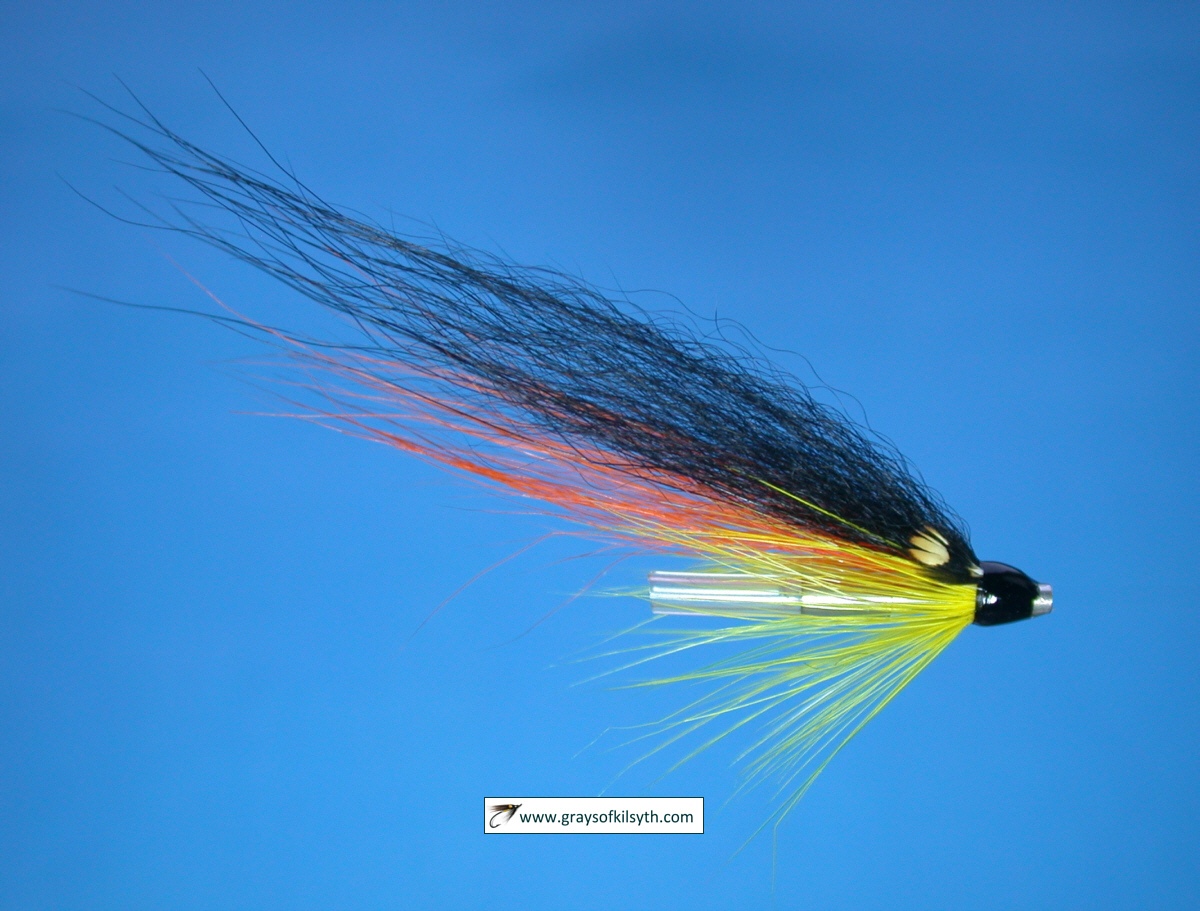
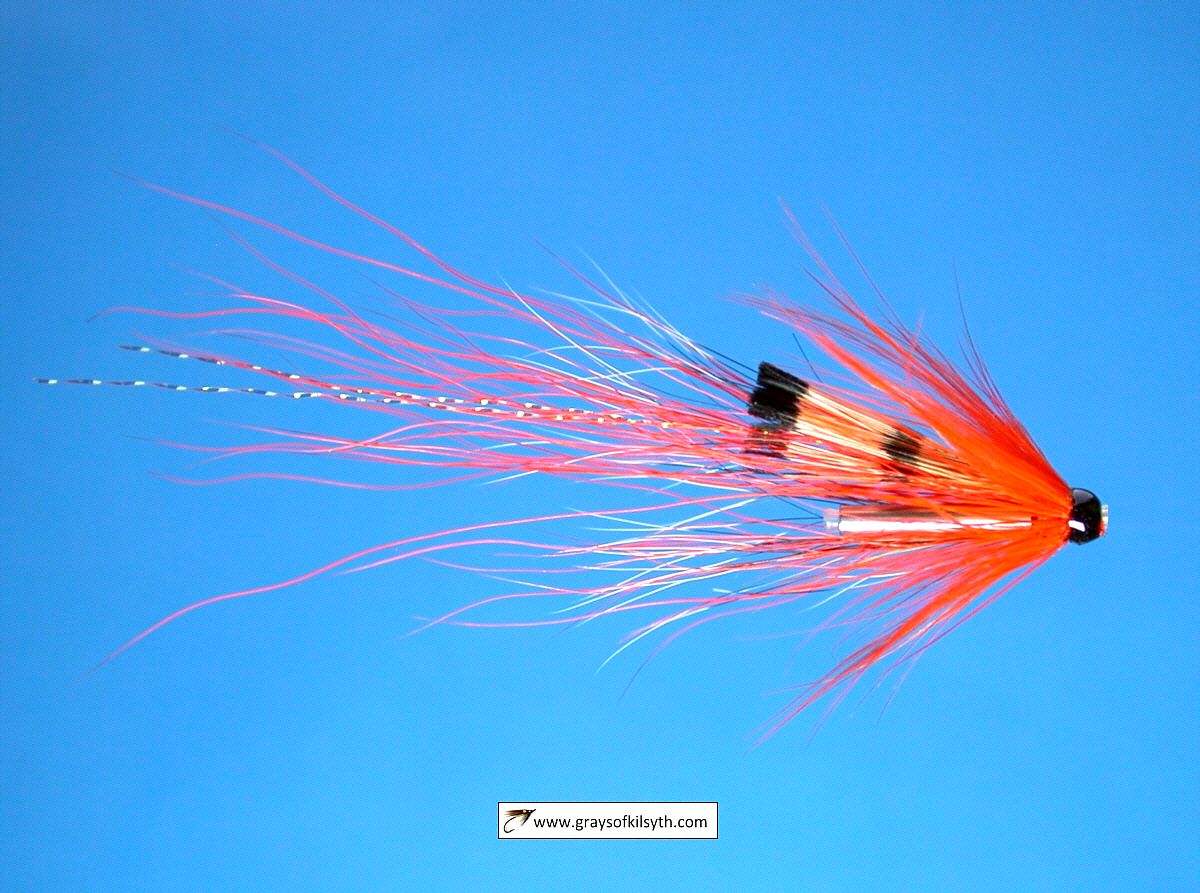
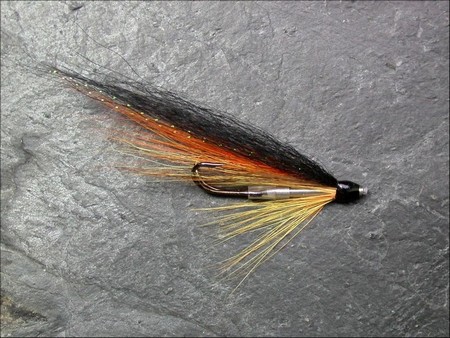
Two salmon flies are shown below.
Which one is dressed upside down?
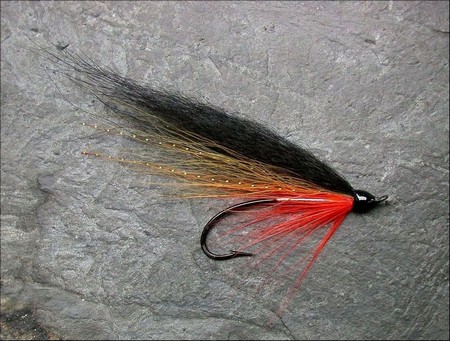
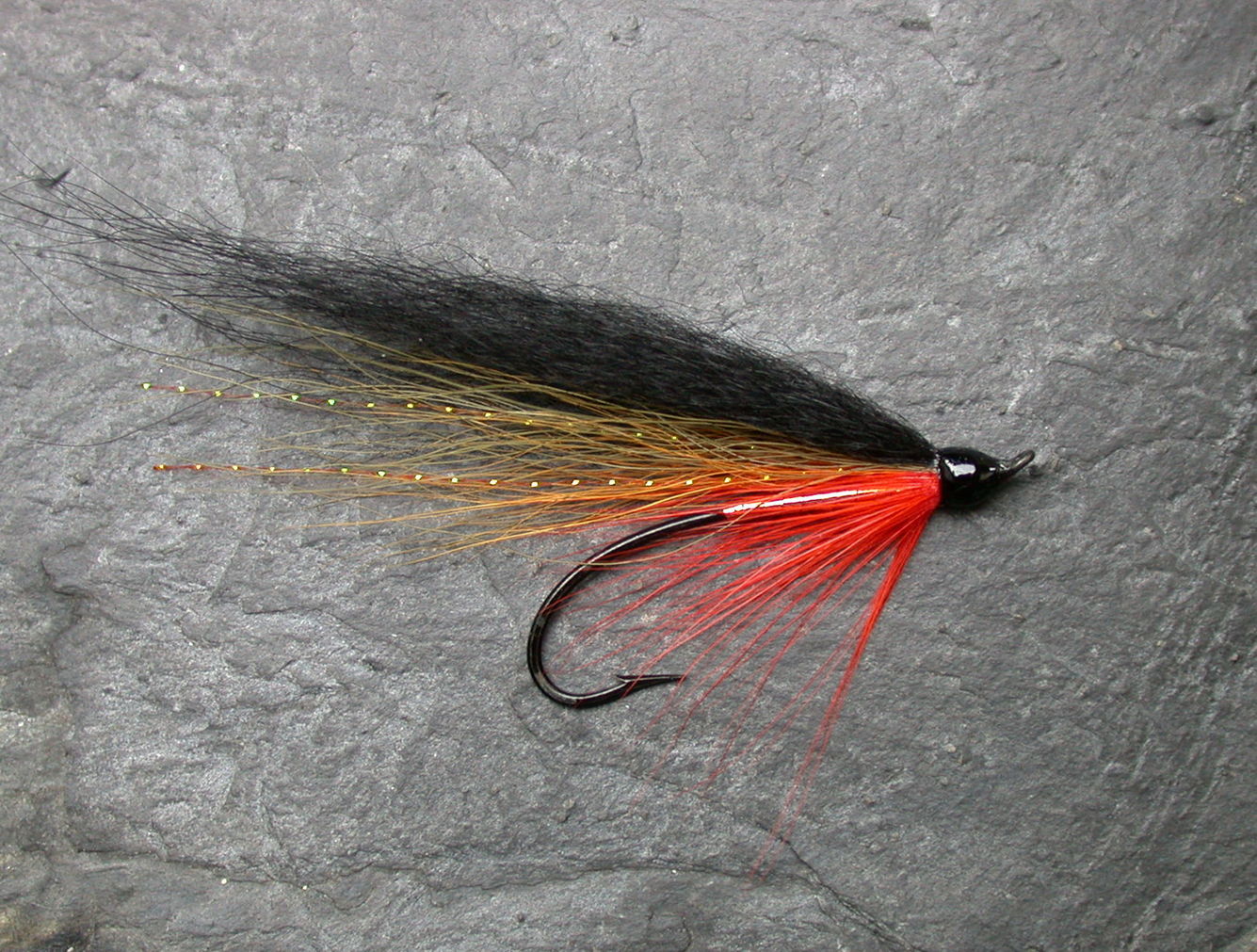
Fly No. 1
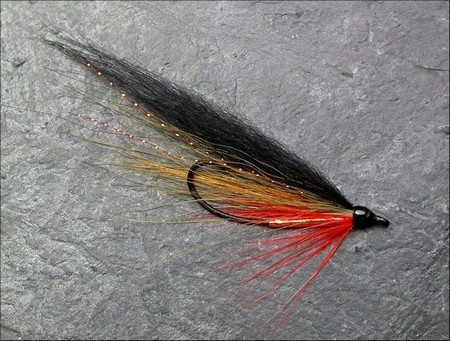
Fly No. 2
Now
before answering this question, I would ask you to go immediately and
run a bath. While the bath is running, go to your fly tying station, or
tackle box, and gather as many different shapes and sizes of single hook
as you can lay hands on. You should also gather a few doubles for good
measure, perhaps even a treble or two. Cut a length of about three feet
of fine fly tying thread. Take the assembled assortment of hooks and
thread to the bathroom and, when you have a foot or so of water, turn
off the bath tap. Now take each hook in turn, thread the fly tying
thread through the eye of the hook and even up the ends of the thread.
Now you have a doubled length of thread about 18 inches long with a hook
on the end. Drop each hook, so attached, in turn into the bath and pull
it through the water. Note that fine thread will inhibit the natural
balance of the hook to a lesser degree than nylon line.
I
expect that your experiments will show, as mine did, that both single
and double undressed hooks, when pulled through the water, swim
naturally with points uppermost, while a well-balanced treble hook, with
all three arms of identical shape and weight, will tend towards no
particular orientation, being stable irrespective of the position of the
three hooks.
Is it
logical, then, we might ask, to dress our single and double hooked
salmon flies, or our trout and sea trout flies for that matter, so that
they swim "upside down", i.e. contrary to the natural tendency of the
hook to swim with points upwards? What advantage do we gain by so doing?
I must say that no obvious advantage springs immediately to my mind.
It
might be said, certainly, that the conventionally dressed fly No. 1
above "looks better". It does to me, but I suspect that this is due
merely to traditional custom and practice, to a long held preconceived
notion of how a fly should look. Certainly there can be no denying that
salmon flies and trout wet flies dressed in the conventional manner
work. Furthermore, if dressed, as most flies are, with the bulk of the
dressing on the side opposite the hook point, the fly will normally
swim, as the dresser intended, with hook point down, the buoyancy of the
dressing overcoming the natural physical tendency of the hook, when
pulled through the water, to swim with its point or points uppermost.
Is
there any worthwhile benefit to be gained, then, by dressing our single
and double hooked flies in line with their natural tendency to swim with
hook points up? I think that there may be. For example, would the hook
point on a fly dressed in the manner of fly No. 2 above not be more
easily hidden in the fly dressing, among the hairs of the wing, and
therefore less conspicuous to a fish? Would a long hair wing not be less
liable to get caught up on the underside of the fly hook? Would the hook
point, swimming on the top side of the fly, not be less readily damaged
on a rocky riverbed, or less easily caught up on riverbed weed? In the
autumn, would the hair wing not act to an extent as a hook guard,
reducing the likelihood of leaves being hooked while fishing?
Would a fly so dressed not be more stable
in the water, the orientation of the hook assisting, rather than
opposing, the fly's natural equilibrium, thus helping to keep it on an
even keel, especially in a rough, turbulent river current?
Of course, the dressing of flies with an
upturned hook point is not a new idea. Many dry flies are dressed in
this way. Also up-pointed saltwater lures, such as the Clouser Minnow,
are common enough, although saltwater patterns so dressed often
incorporate weighted dumbbell eyes in part to ensure the fly swims point
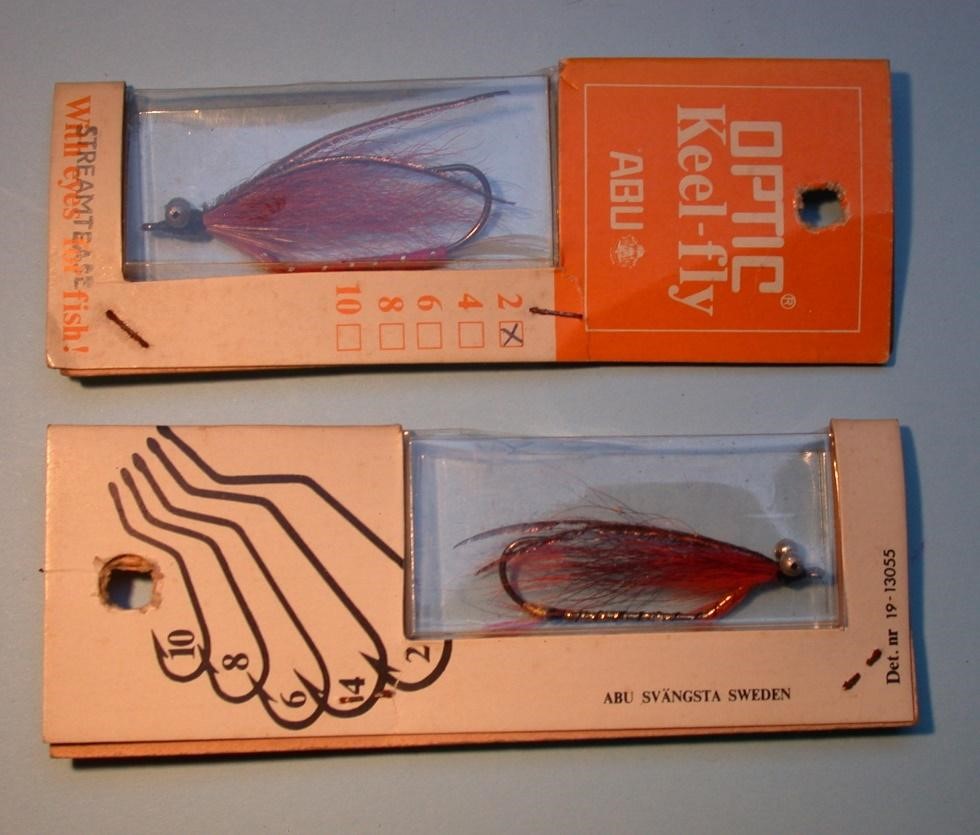
upwards. Abu of Sweden once marketed a range of “Keel Flies” dressed on
specially designed keel hooks made by Mustad, to help prevent deeply
fished lures from hooking the river bed.
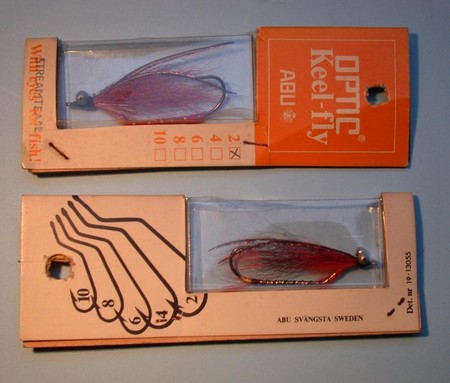
The “Streamtease” and “Callgirl”
Optic Keel Flies by Abu
Many tyers of the North American
“Intruder” style of lure set the trailing single hook with point
upwards, recognising that this will aid the balance and stability of the
lure. There may well be many other examples of flies and lures dressed,
for a variety of reasons and uses, in this way.
Atlantic salmon fishing, however, has no
tradition of flies dressed on an upturned hook. One possible reason for
this is perhaps that the upturned hook might have been an inconvenience
when dressing the early fully dressed feather winged salmon flies. Or it
may be simply that the tyers of trout and salmon flies believed, as many
still do, that downturned hook points, on single and double hooks, act
as a kind of keel, giving stability to the fly. In fact, a fly dressed
with the hook points facing downwards only maintains this position while
fishing owing the buoyancy of the wing keeping it upright. Any imbalance
in the dressing of such a fly, particularly on a heavy hook, is likely
to see it swimming on its side or even upside down, in line with the
natural tendency of the hook to swim hook points up. Indeed, our
bathroom tests indicate that the most stable fly will be one dressed on
an upturned single or double hook (i.e. hook point up), with the bulk of
the dressing applied on top, i.e. on the same side as the hook point,
which will ensure that the fly/lure swims hook point upwards, with no
need for added weight or specially designed hooks. The traditional
“up-eye” single and double salmon hooks are well enough suited to this
style of dressing (but with the “up-eye” turned down of course), as
illustrated in Fly No. 2 above.
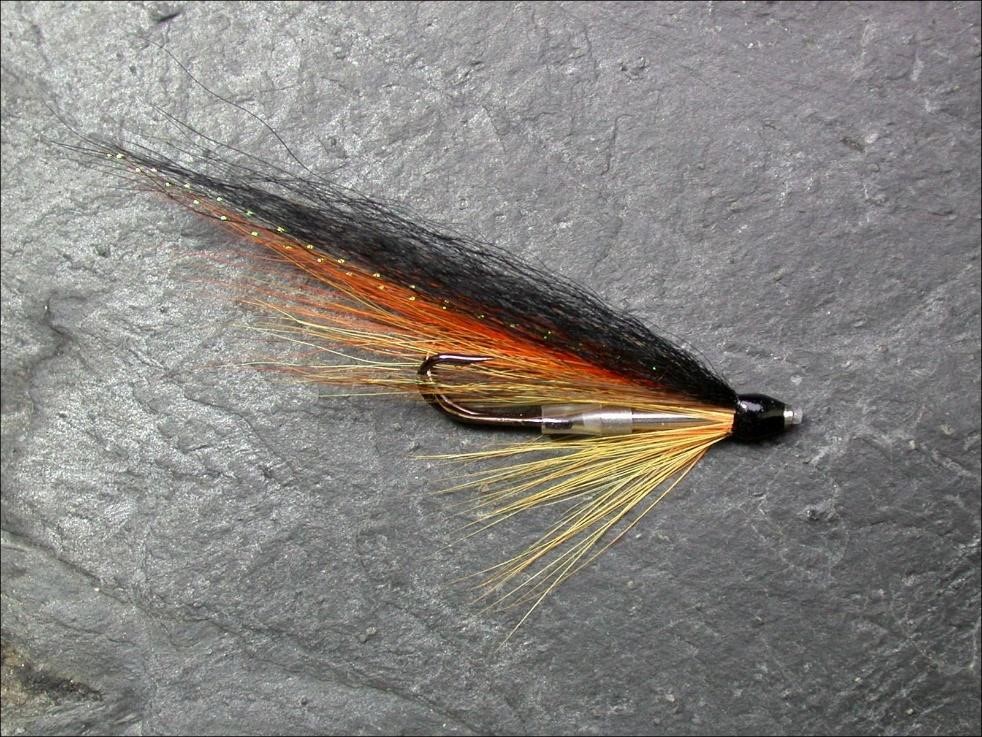
How a Salmon Single Swims
When attached to a line and held in a current, as in a typical fishing
situation, a salmon fly, whether dressed with hook up or down, will tend
to swim with the rear of the hook at a lower level than the eye, as
illustrated in the two photographs below. The degree of rear end droop
will depend on the strength of the current or the speed of retrieve -
the faster the fly moves relative to the speed of the flow, the less
pronounced will be the rear end droop.
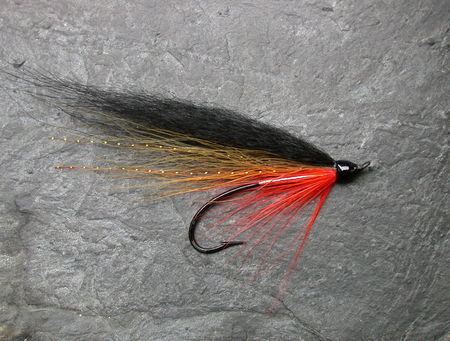
Fly dressed with hook point down while fishing
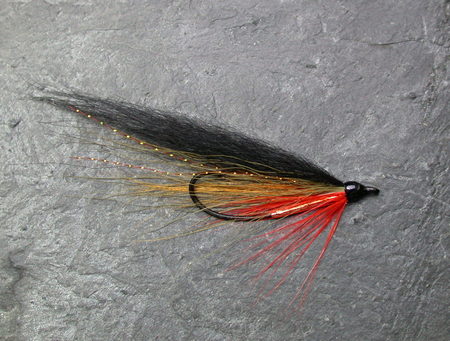
Fly dressed with hook point up while fishing
Dressing a Salmon Fly on an Upturned
Double Hook
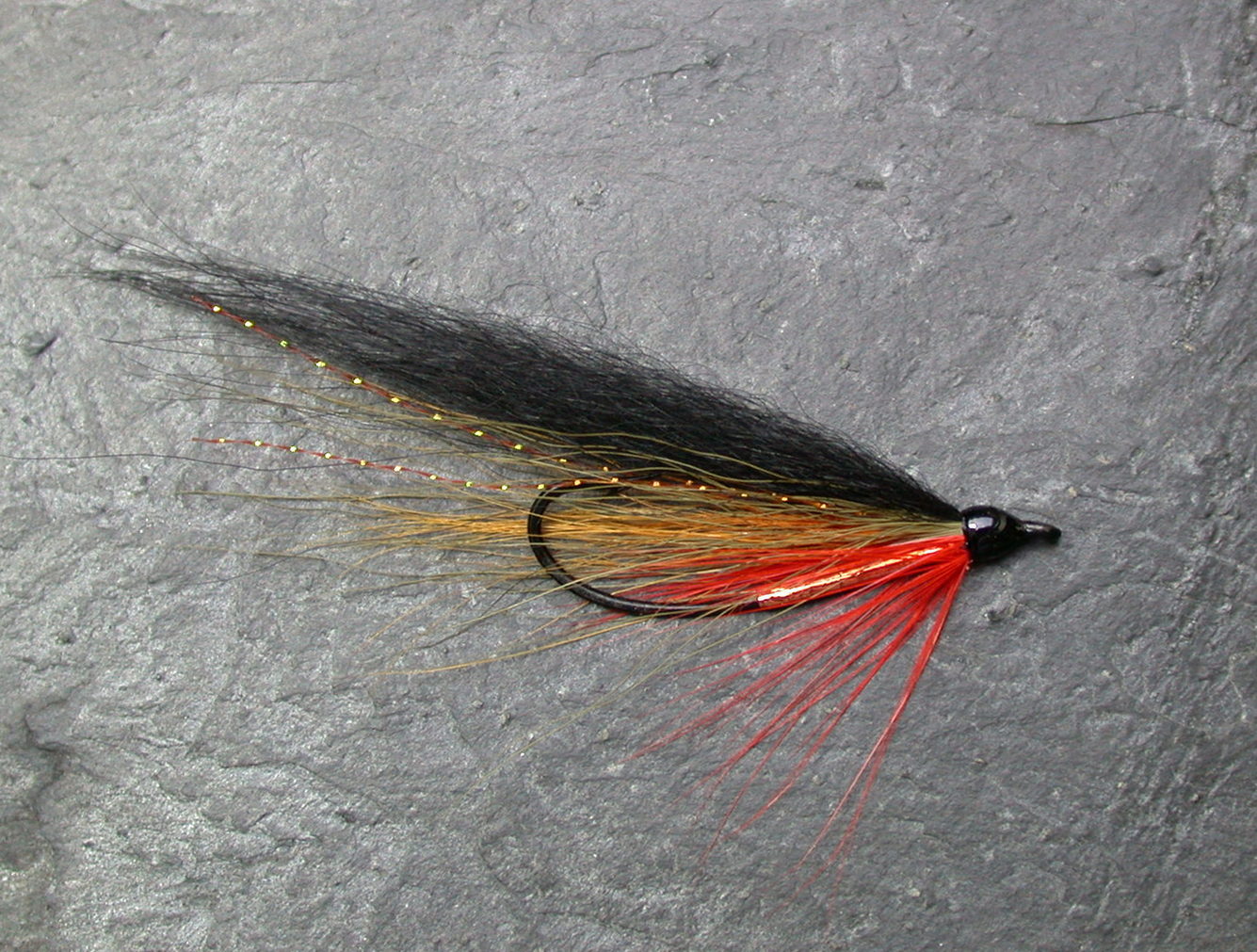
Illustrated below is a step by step
sequence for the dressing of a Cascade variant on an upturned salmon
double. Note the deviation from the standard tying method, in that there
is no “tail” as such in this dressing, the tail and wing being combined
and tied in near the head of the fly, allowing greater mobility. The
bucktail lies neatly between the two arms of the double hook, with no
possibility of the wing being caught up on the underside of the hook
while fishing.
Step by Step Tying Instructions
Hook:
Low water Wilson Double
Body:
Rear silver tinsel, front black floss
with silver oval rib
Wing:
Yellow, orange and black bucktail with
two strands of Krystal Flash
Hackle:
Yellow and orange Rooster
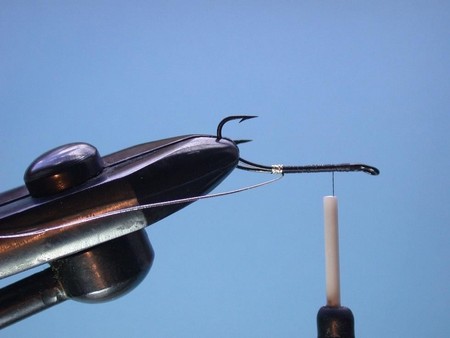
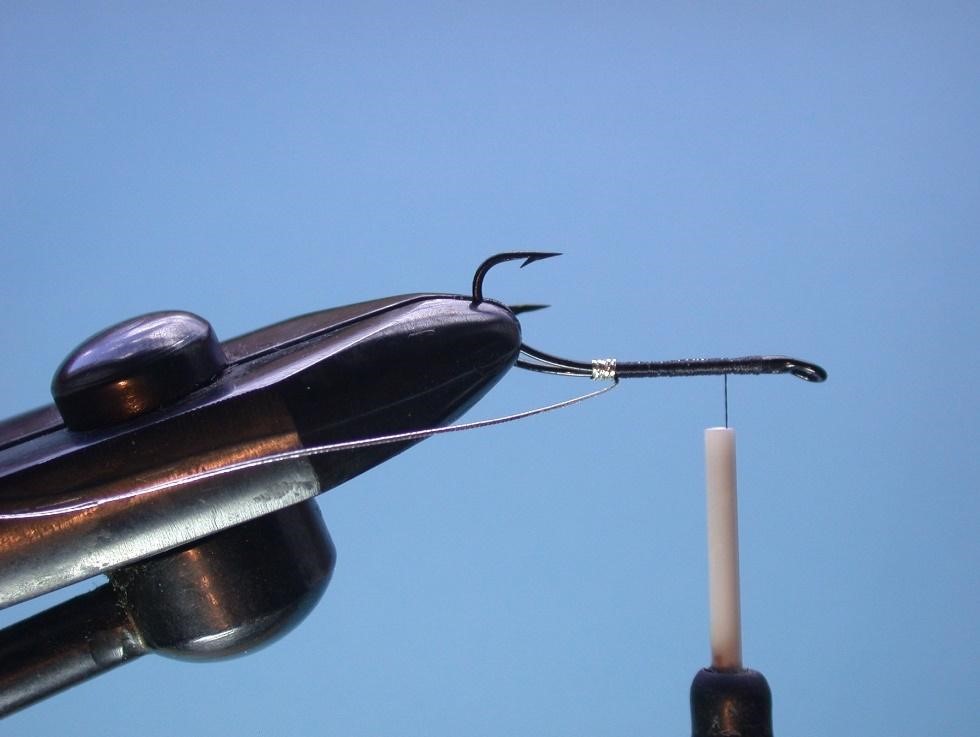
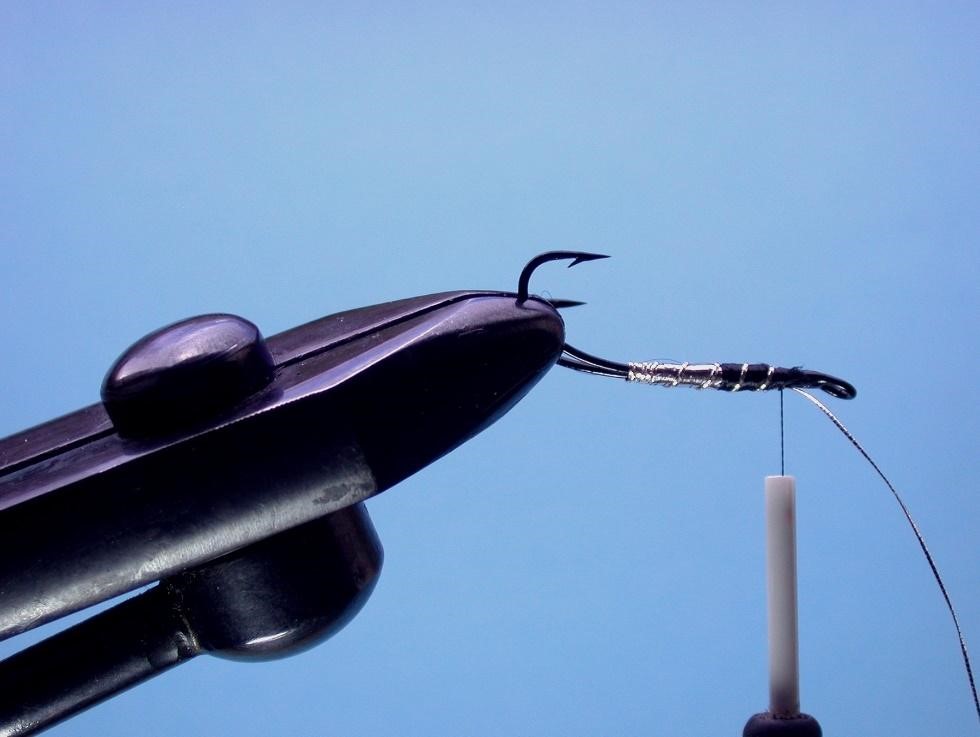
Step 1 – Wind thread from hook eye along
straight section of shank, tie in oval tinsel tag and wind thread back
up hook shank
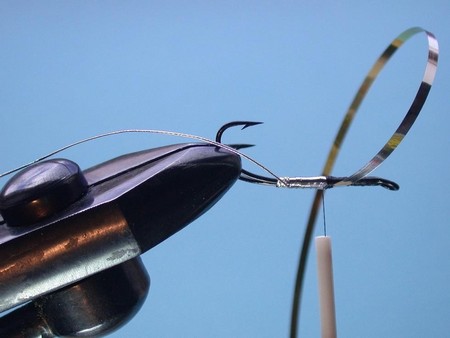
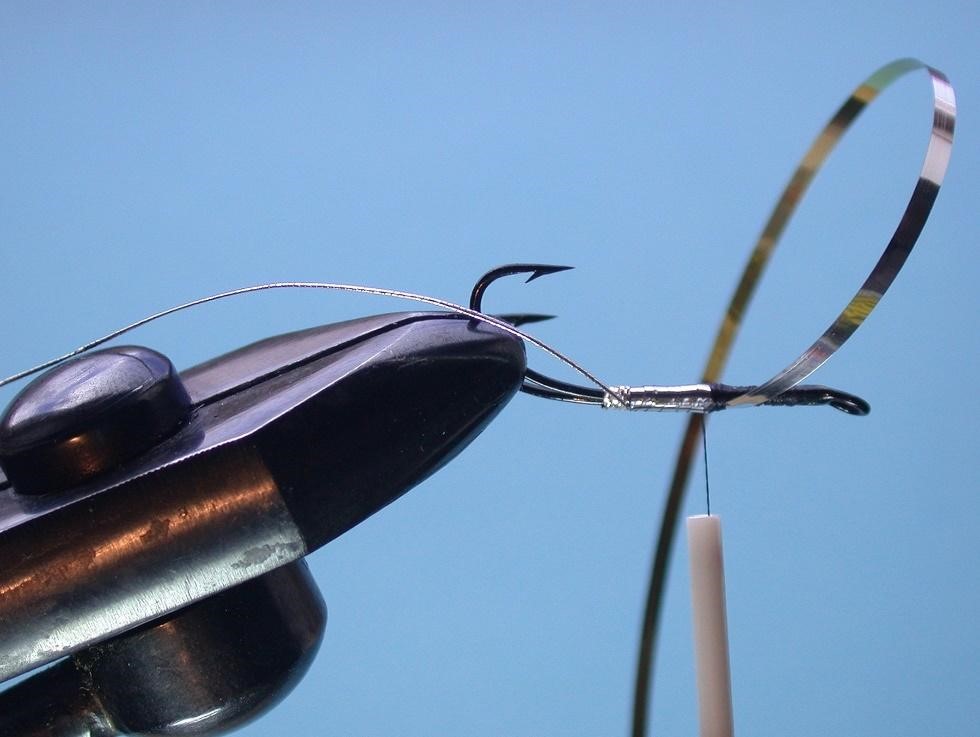
Step 2 – Wind silver tinsel down to the
tag and back to half way up the shank
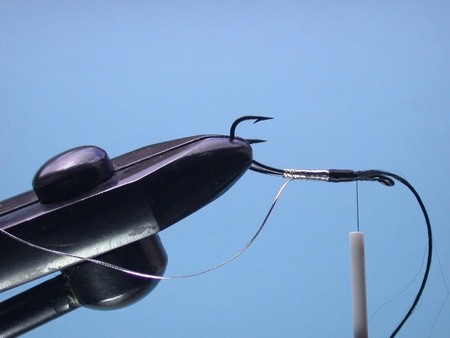
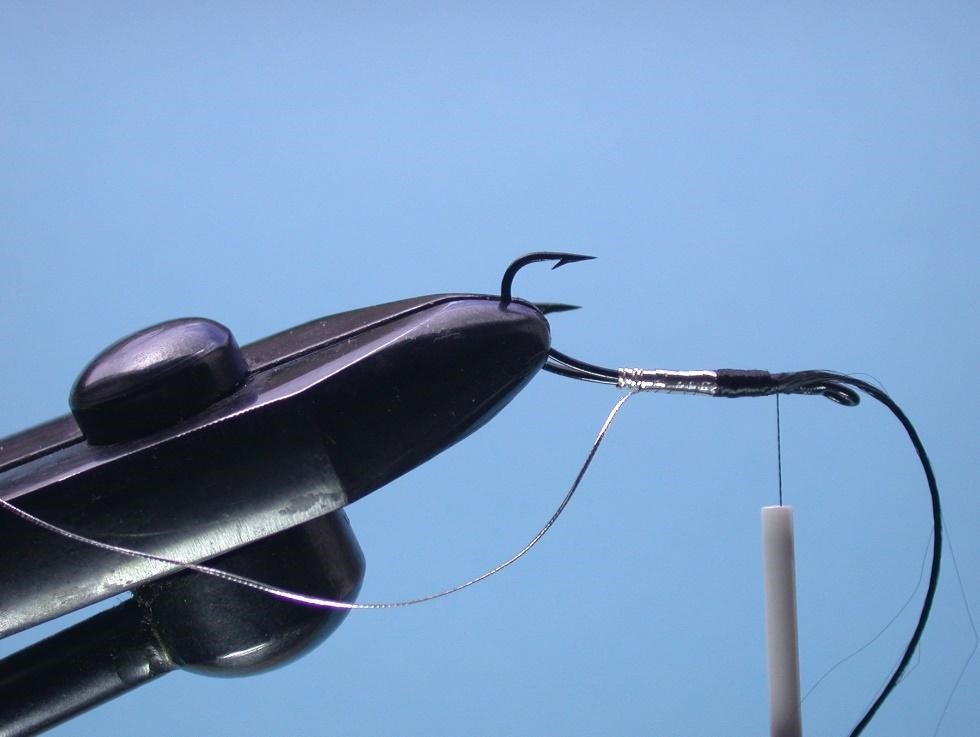
Step 3 – Wind black floss, leaving
plenty of room for wing and hackle
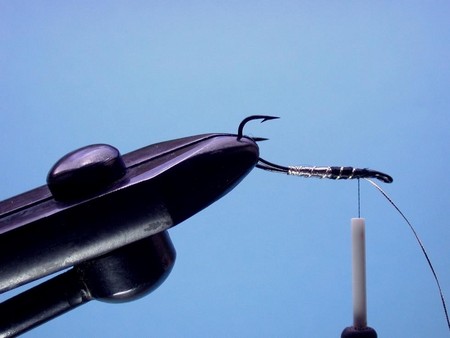
Step 4 – Wind silver oval rib in evenly
spaced turns up over whole body
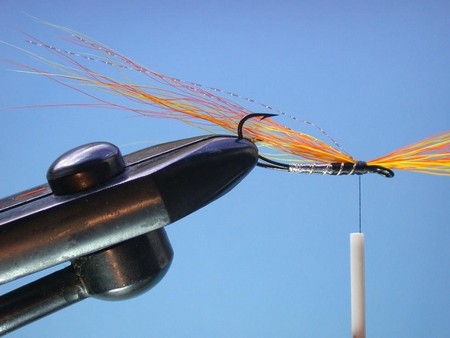
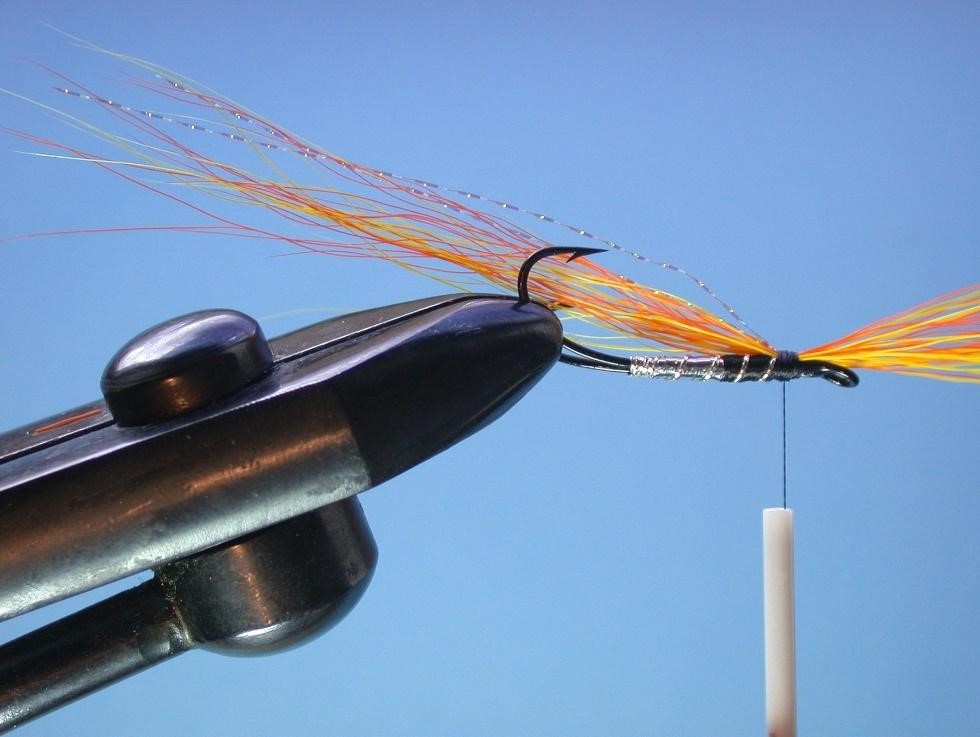
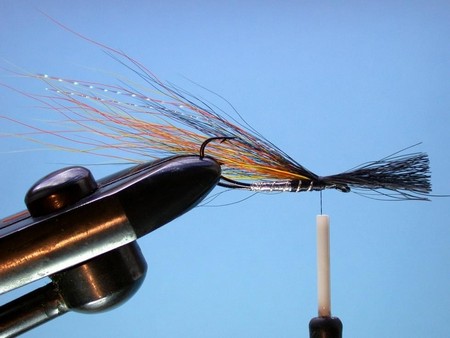
Step 5 – Tie in mix of yellow and orange
bucktail and a doubled strand of Krystal Flash
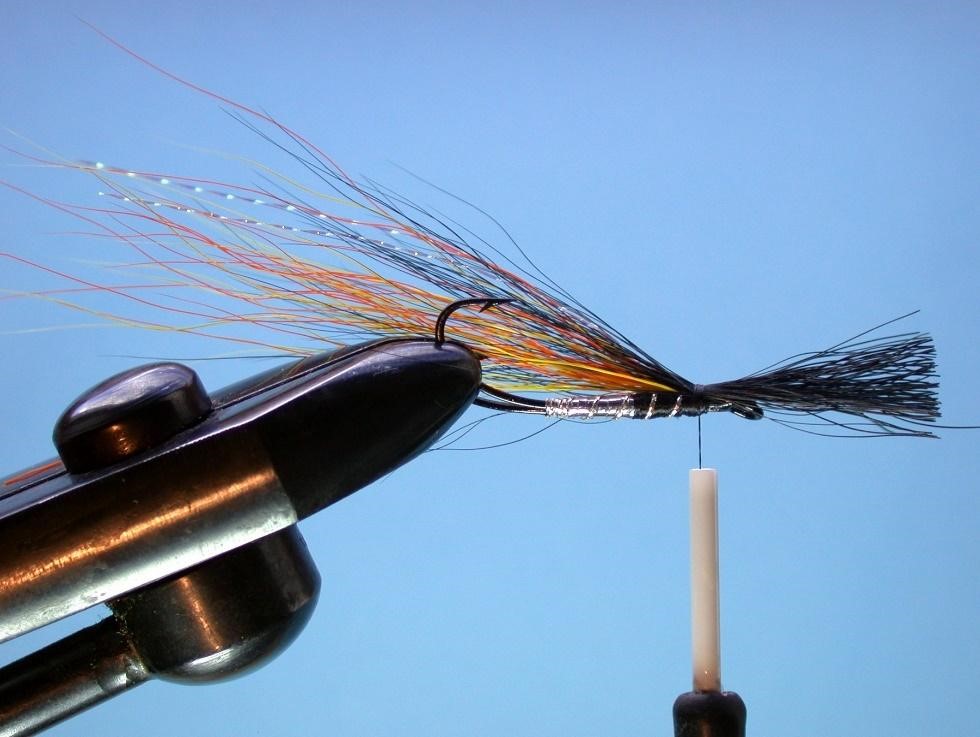
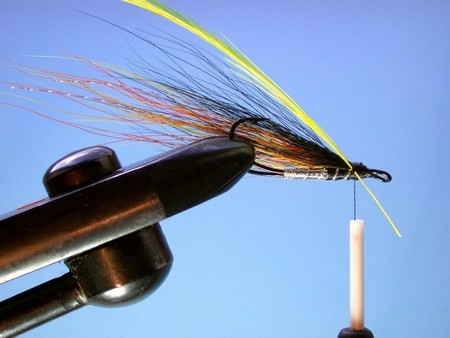
Step 6 – Tie in black bucktail (shorter
than the orange yellow bucktail mix)
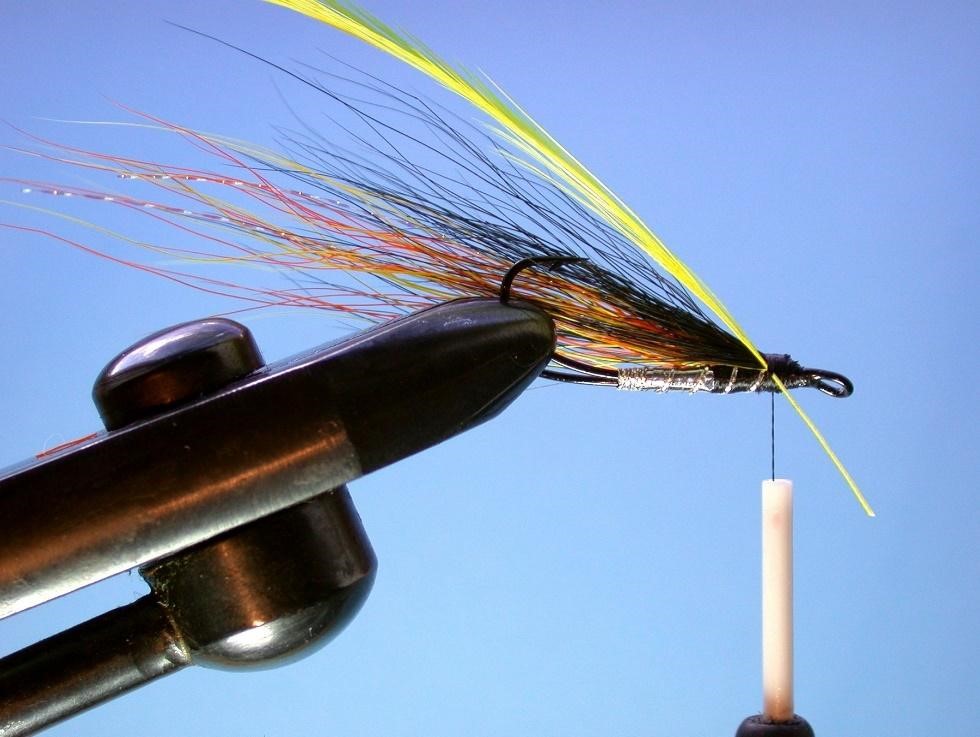
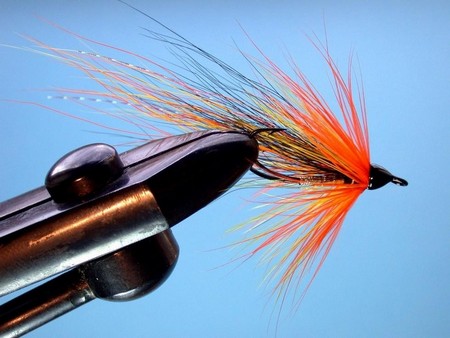
Step 7 – Tie in and wind two turns of a
yellow hackle, followed by two turns of orange hackle
Step 8 – Build a neat head and varnish
This double hooked fly will be very
stable swimming hook points up.
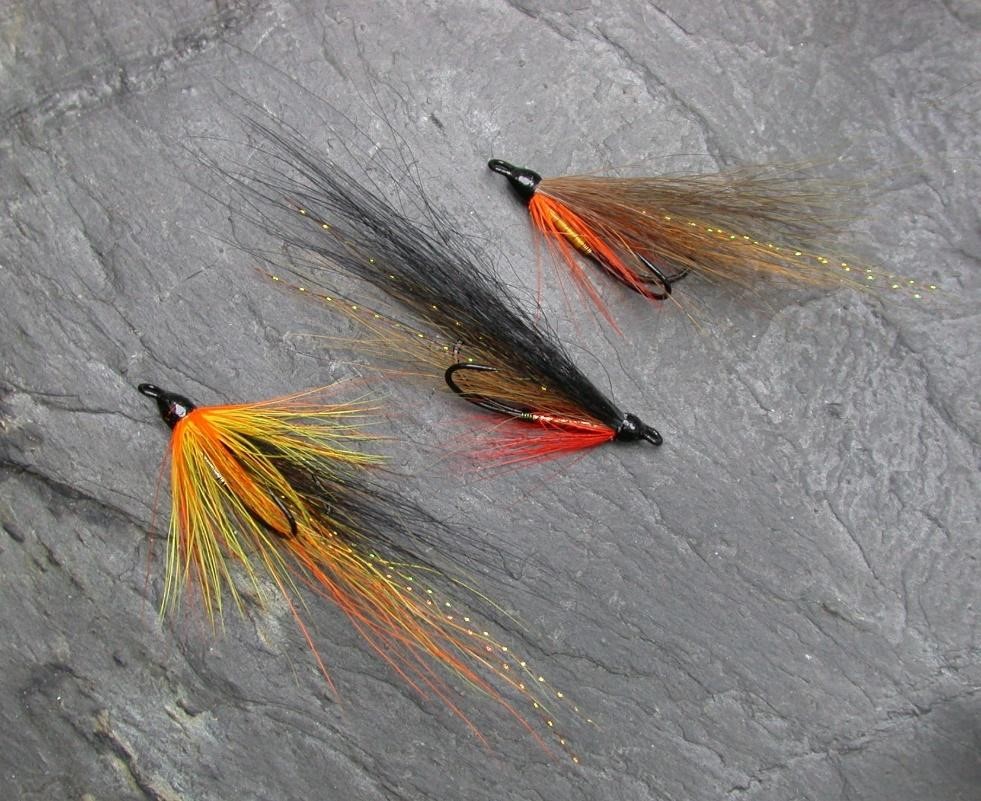
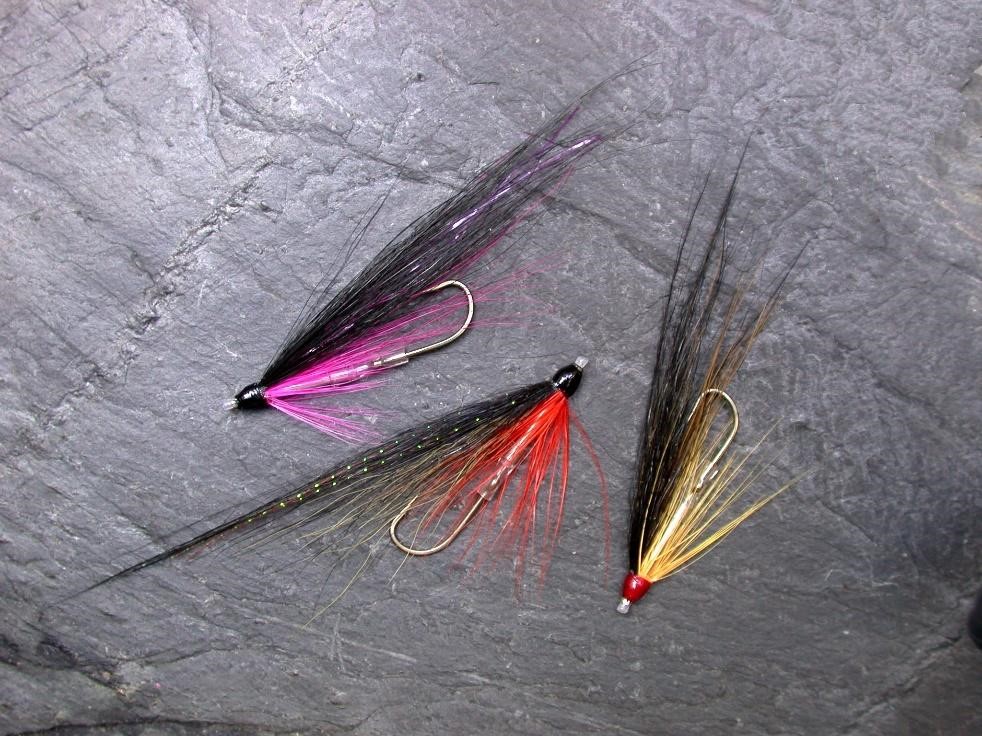
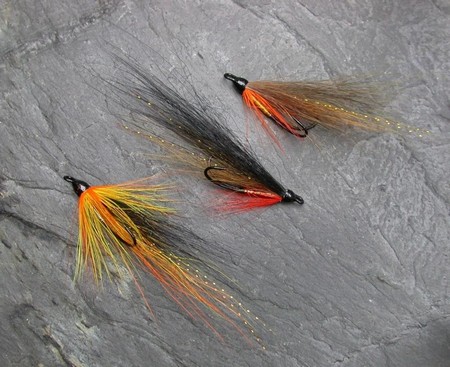
A few more salmon flies dressed on
upturned double hooks …
Tube Flies and Hook Orientation
The above observations, relating to
single and double hooked flies, apply equally to hooks used in
conjunction with tube flies. Salmon and sea trout tubes can be armed,
rules permitting, with single, double or treble hooks, barbed or
barbless. Indeed, this interchangeability of hooks, together with the
tube fly’s consequent improved durability, is a major benefit of tube
flies and a variety of hooks are now sold, by companies such as Loop,
Partridge, Fulling Mill and Ken Sawada, to name but a few, specifically
for use with tube flies.
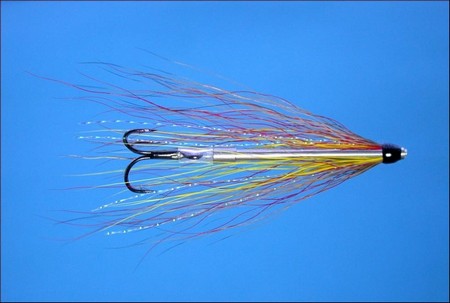
If using a well-made treble hook, with all arms of the treble of equal
weight, the positioning of the treble will make no difference to the way
the tube fly swims. The treble hook will be in a state of balance, and
equally stable, no matter how the arms of the hook lie and will have no
natural tendency to rotate to reach a particular position. A treble
hook, either dressed or attached to a tube fly, will swim naturally with
the bulkiest/most buoyant materials on top, although I think that treble
hooks are more suited to tube flies with materials dressed all round,
with no top or bottom, as in the traditional Willie Gunn style of tube
shown below.
Salmon tube fly armed with a treble hook
The attachment of double and single hooks, increasingly popular with the
currently growing focus on catch and release and associated regulation
of angling methods and tackle, will be more influential in determining
the way the tube fly swims. As our tests have shown, an undressed
single or double hook will, as a rule, tend to swim naturally, and will
be most stable, with hook points up. So, when attaching a single or
double hook to the rear of a tube fly, it would be advisable to connect
it with the hook points uppermost, i.e. hook points towards the
bulkiest, most buoyant side of the tube. This will add to the stability
of the tube fly, reducing any tendency for the fly to swim upside down
or on its side. The aforementioned additional benefits, of protection of
the hook point etc., gained by dressing double and single hooks with the
points uppermost, also apply to the upward setting of the hook on a tube
fly.
Hook Options for Tube Flies
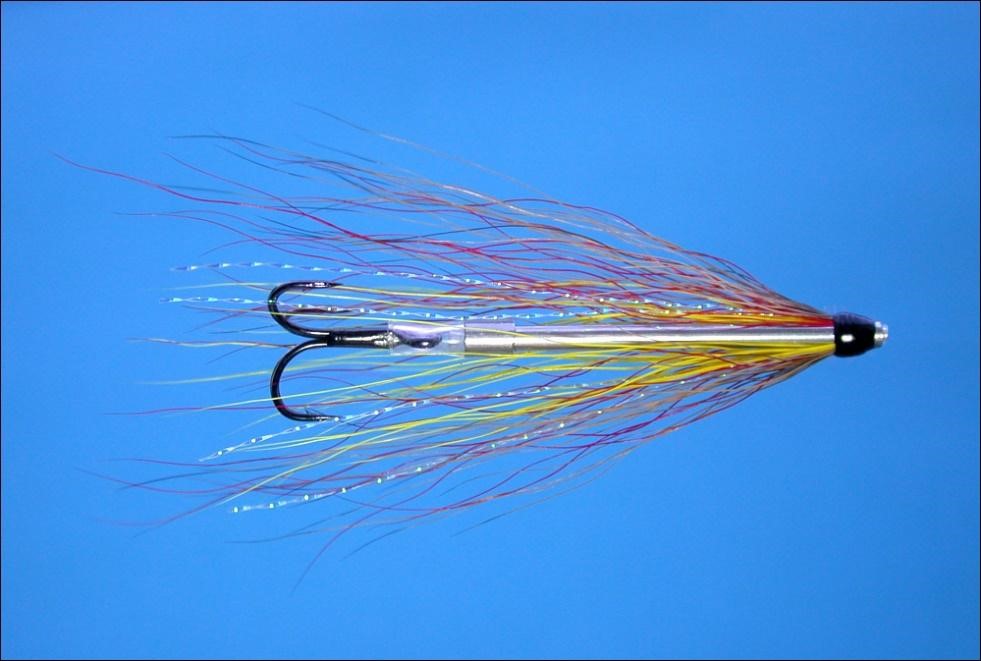
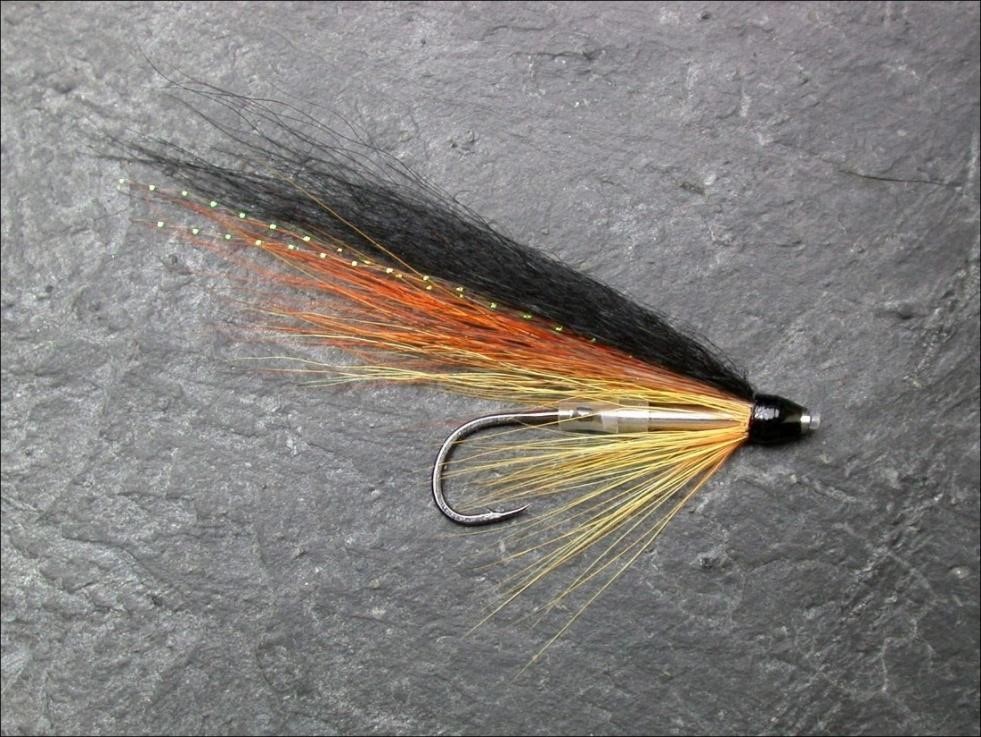
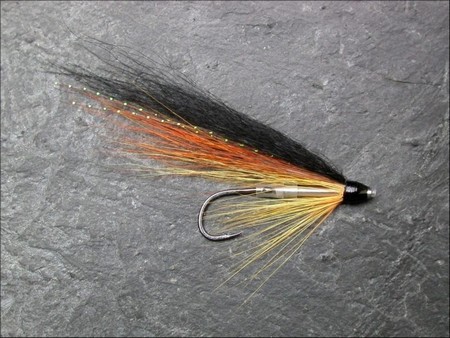
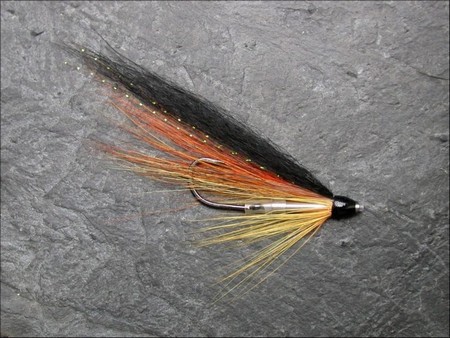
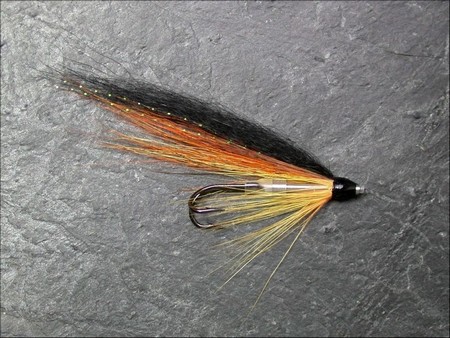
Four possible options – for a salmon fly
dressed on a small tube, fitted with a single or double hook - are
illustrated below....
Tube with downturned single hook
Tube with upturned single hook
Tube with downturned double hook
Tube with upturned double hook
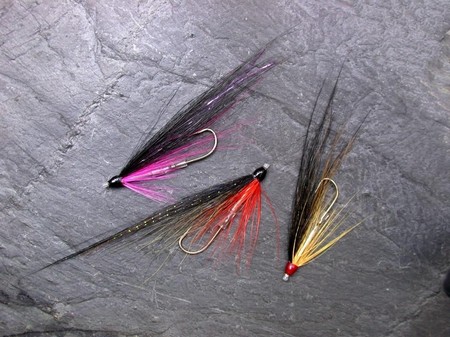
A few tube flies are shown above, armed
with an upturned single hook (Drennan Specimen hook in sizes 8 and 6),
intended for sea trout or summer salmon.
Whether using singles
or doubles, a tube fly will be more stable fished with hook points up.
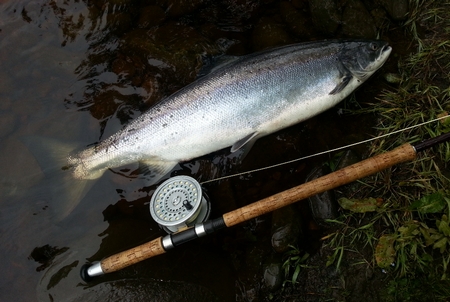
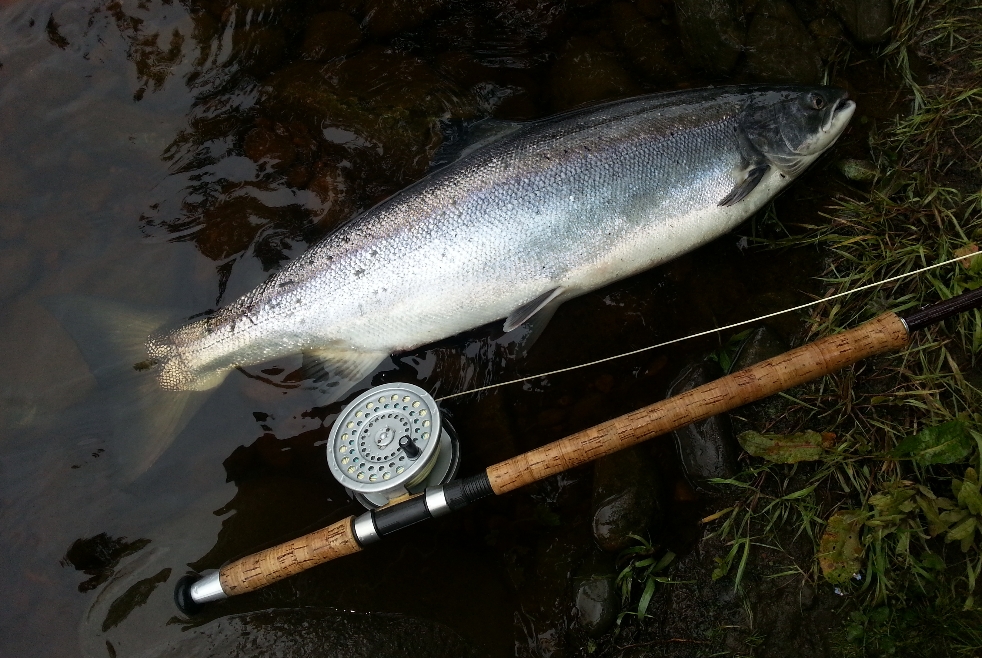
This 13 pound South Tyne salmon took a
tube fly armed with an upturned double hook
In conclusion, it
would seem to me that fishing our flies with hook points up might offer
several practical benefits with no discernible disadvantages ….. All
“upside” and no “downside”, so to speak.
Indeed, we might well
ask whether, for centuries, we have dressed and fished our trout and
salmon fly hooks upside down!
.......................................................................................................................
See also
Salmon Fly Hooks For more information on, or to buy, Salmon, Trout and Sea
Trout Flies, see
Trout and Salmon Flies |