The Origin and Development of the Needle Fly
continued from the needle fly
Using the Needle Fly
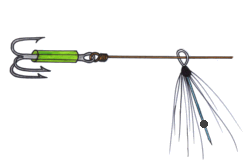
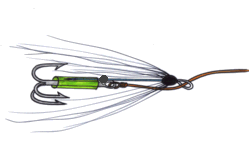
To attach the Needle Fly
to the fly leader, simply thread a Needle Fly on to the leader (as you
would a tube), tie on a suitable size treble hook (complete with
rubber/plastic sleeve) then insert the needle firmly into the sleeve
until the thread stop on the needle touches the sleeve. Fix the needle
on the top of the treble hook with the leader lying along the underside
of the needle.
|
SAFETY
Fishing hooks and
needles may cause injury.
The construction of the
Needle Fly, as in all fly tying, involves the risk of minor injuries
from hook and needle points etc.
It is essential that you wear a safe and effective form of eye
protection, such as safety glasses, when handling and using needles
and fishing hooks, as needles and some hooks are brittle and may
break when bent.
It is also important to wear effective head
and eye protection when fly fishing. |
I would say, in
conclusion, that the most crucial component of the needle fly is the
tubing used for the treble sleeve. It should be strong and durable but
with enough flexibility/elasticity to grip the needle firmly. It is most
important, in construction, to match the diameter and wall thickness of
the tubing to an appropriate size and weight of treble hook, both of
which must then be matched to an appropriate length and diameter of
needle. For example, let's say you begin with a size 8 treble made from
a heavy wire. A narrow tube with a diameter of 1mm will not fit over the
eye of the hook. You will need tubing with a 1.5mm bore. If you begin
with a fine wire size 14 treble, the 1.5 mm bore tubing will be much too
large. But even when you have found a type and size of tubing to match
the size and weight of the treble hook, you must also match this to a
needle of appropriate diameter. A very thick needle will be difficult to
insert in the sleeve and will possibly overstretch the sleeve. Too thin
a needle might not be gripped firmly enough by the sleeve.
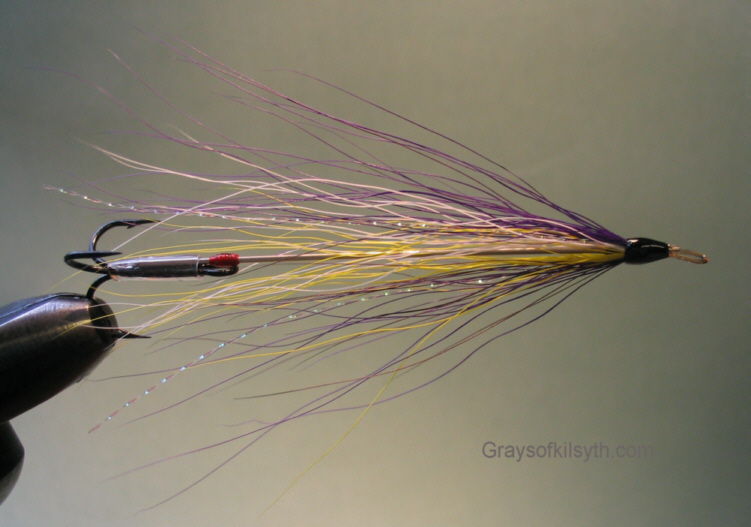
I have found that the needle fly is at its best, as a lure for sea
trout, in lengths between 1.25 inches and 2 inches. Needles are
available in different gauges. The finest are labelled Sharps, while
the slightly heavier gauge are called Betweens. By using the two
types, it is possible to vary the weight of the fly.
In tying your own needle flies, I would recommend you start with a Sharp needle of around 1.5 inches long and match it to a size 12 fine
wire treble
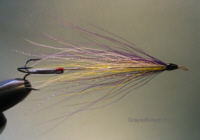 hook,
with a smooth medium length shank, matched to a suitable sleeve with a
bore of around 1mm. You can experiment from there. For those who find
the components difficult to get hold of, a
Needle Fly Kit
is now available. I had at first hoped that I might get away with
a simple needle, held in place on the treble by a tightly fitting
sleeve. However, in order to prevent the needle slipping through the
sleeve when casting (when it is subject to enormous force), I decided I
needed a stop of some kind, fixed on to the needle. I have tried blobs
of glue, short lengths of very fine heat shrink etc. but have now
settled on a small but tight wrapping of tying thread coated with a drop
of varnish. Do not tie the stop too near the end of the needle. To
ensure a good grip, the point of the needle should, when assembled, be
at the rear end of the sleeve or even protruding slightly. For this same
reason, it is unwise to use a treble hook with too short a shank. You
can read more about the tying of the needle fly
here hook,
with a smooth medium length shank, matched to a suitable sleeve with a
bore of around 1mm. You can experiment from there. For those who find
the components difficult to get hold of, a
Needle Fly Kit
is now available. I had at first hoped that I might get away with
a simple needle, held in place on the treble by a tightly fitting
sleeve. However, in order to prevent the needle slipping through the
sleeve when casting (when it is subject to enormous force), I decided I
needed a stop of some kind, fixed on to the needle. I have tried blobs
of glue, short lengths of very fine heat shrink etc. but have now
settled on a small but tight wrapping of tying thread coated with a drop
of varnish. Do not tie the stop too near the end of the needle. To
ensure a good grip, the point of the needle should, when assembled, be
at the rear end of the sleeve or even protruding slightly. For this same
reason, it is unwise to use a treble hook with too short a shank. You
can read more about the tying of the needle fly
here
My fishing diary
of 1999 records that, in eighteen hours of night fly fishing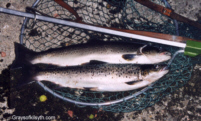 on the Crieff Angling Club stretch of the River Earn, between 25th
June and 7th July, I had seven sea trout, the Needle Fly
accounting for six of these, weighing between two pounds and four and a
half pounds. Since its early successes on the River Earn, the Needle Fly
has become my favourite fishing lure for late night sea trout. It is
also useful earlier in the night when the river is running a bit high or
cold, particularly in early season and, in addition, it has accounted
for a few salmon.
on the Crieff Angling Club stretch of the River Earn, between 25th
June and 7th July, I had seven sea trout, the Needle Fly
accounting for six of these, weighing between two pounds and four and a
half pounds. Since its early successes on the River Earn, the Needle Fly
has become my favourite fishing lure for late night sea trout. It is
also useful earlier in the night when the river is running a bit high or
cold, particularly in early season and, in addition, it has accounted
for a few salmon.
I have to thank
the editor of Trout and Salmon magazine for his permission to use
extracts from my article "Needles for Sewin", which appeared in the
September 1999 issue of that esteemed publication.
more fishing
articles
|
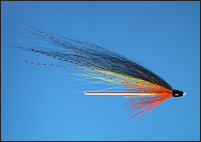
See
also the new Needle Tubes at
Grays of Kilsyth
|
|