Sea Trout Fishing - Where to Fish
A brief outline of where to fish for sea trout in the
British Isles
He takes again the well worn path
his craft to nightly ply
On quiet summer pools where sewin
silver sleeping lie
Like precious stones they shine
unseen beneath the silent stream
Elusive pearls that haunt the
dreams that sea trout fishers dream
So where should we start? The first thing
to note is that not all rivers in the British Isles are
good sea trout rivers. We might begin by asking, then,
What makes a good sea trout river?
This question may be taken in two ways.
Does it relate to a river's suitability as a sea trout
producing river or as a sea trout fishing
river? Naturally, to be a good sea trout
river,
in any sense, a river must have the capacity to produce
a good stock of sea trout but not all sea trout
producing rivers make good sea trout fishing rivers.
Looking first at the characteristics likely to produce
sea trout, I would think that the best sea trout rivers
would meet the following criteria:
1. They would be free of any major obstacles to allow
the easy passage of returning sea trout. This would
include barriers, nets, estuary pollution, predators,
anglers etc.
2. They would have an abundance of accessible spawning
and nursery streams with suitable spawning gravel and
clean water. Although likely to be acidic and lacking in
trout food, they would have a steady supply of clean,
unpolluted water but not prone to excessive winter
flooding. It would be preferable if the spawning
conditions were less suited to salmon so that the
trout/sea trout would face less competition for space on
the spawning and nursery streams.
3. They would be relatively free from predators e.g.
sawbill ducks, mink, eels etc.
4. They would likely be fairly acidic, barren waters,
but with an extensive system of nursery streams, able to
sustain a large number of juvenile trout but unable to
support a similarly large stock of good sized brown
trout, thus providing an incentive for the majority of
young fish, particularly the females, to run to sea in
order to find food.
5. The sea trout smolts would have a free, unhindered
passage on their seaward migration, with a minimum of
predation, pollution and obstruction. There should be no
salmon farms within a hundred miles of the river mouth.
6. There should be rich marine feeding in the vacinity
of the river mouth with a minimum of exploitation of the
sea trout's prey species, in particular there should be
no netting of sandeels.
(For a light-hearted take on what
makes a sea trout, see
Should I Stay? )
As to what makes a river a good sea trout fishing river,
that is perhaps more difficult to define. In addition to
the above qualities, I like a river with the following
characteristics:
1. It should be generally accessible to all
and
reasonably priced.
2. It should be well managed, maintained and policed,
preferably by well qualified keepers.
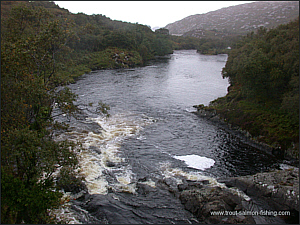
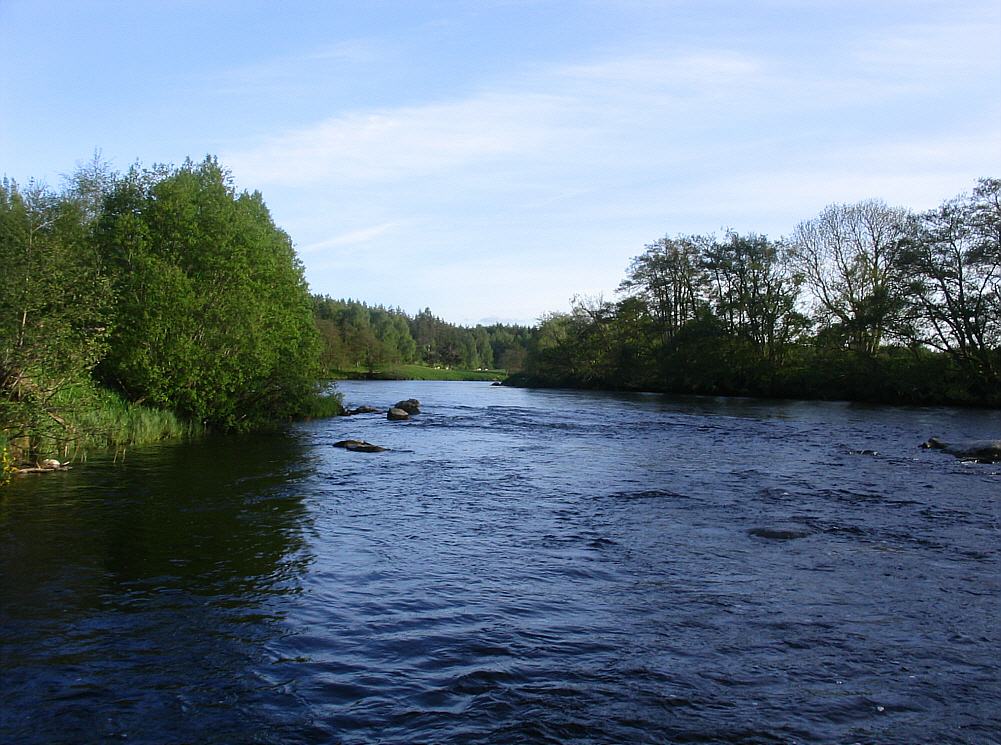
2. It should have a good number of deep holding pools,
throughout its length, with plenty of tree cover, not so
much for fishing but to provide sanctuary for the sea
trout, particularly during daylight hours.
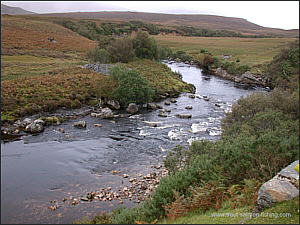
3. Even at summer low levels, it would
have
some streamy water suitable for fly fishing - not rough
water but with enough flow to fish a fly without the
need for hand-lining. This streamy water may be quite
shallow, even a foot of water can hold fish at night.
This streamy water would ideally lie near some deeper
holding water.
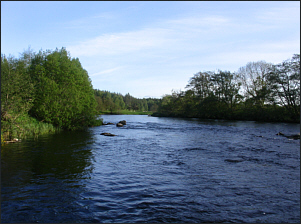
4. The river would flow through a series of "pools" over
a varied bed, with a mix of large stones, shingle and
gravel. The pools should have good tree cover.
5. The river would not be subject to flash floods, all
too common nowadays with the afforestation of the upper
catchments of many rivers. It would clear reasonably
quickly after summer spates and would have a minimum of
weed growth of the kind now common in rivers where an
excess of agricultural fertiliser leaches into the
river.
6. Ideally, the river should have an entirely natural
flow, with no man-made obstructions, no hydro-electric
schemes and no water abstraction of any kind.
Few, if any, rivers are likely to meet
all of the above criteria but there are many rivers
throughout the British Isles which meet enough of them
to qualify as good sea trout fishing rivers. So where
are they?
In England, there are many excellent sea
trout rivers. The South West, in particular, has its
share, the most productive being the Teign, Fowey, Taw,
Camel, Dart, Tamar, Tavy, Avon (Devon), Axe and Lynher.
In the North West, the Lune, Ribble, Hodder, Kent,
Cumbrian Esk and Ehen are worthy of mention and,
historically the most productive of all, the Border Esk,
although most of its sea trout fishing lies in Scotland.
The North East can boast of several excellent, and,
against the general run of things, improving sea trout
rivers, for example the Tyne and Wear, with the Coquet
and Yorkshire Esk having smaller, but worthwhile, runs.
Next we come to Wales, where sea trout,
or sewin, fishing vies with rugby as the national sport.
There are numerous sea trout rivers in all parts of
Wales, the most productive being the Towy (Tywi), Teifi,
Dovey (Dyfi), Clwyd, Conway (Conwy), Nevern, East and
West Cleddau, Rheidol, Mawddach, Glaslyn, Taf and Ogmore.
In Ireland, sea trout are taken in the
Currane/Waterville system, Kerry; the Cashla and
Ballynahinch, Connemara; the Feale, Limerick; the
Owenduff and Owenmore, Bangor; the Slaney, Wexford; the
Bundorragha, Erriff and Dawros, Ballinakill; the Munster
Blackwater, Lismore; the Boyne, Drogheda; the Bandon,
Cork, to name only a few of the main rivers. In Northern
Ireland, we have the Bush, Bann, Faughan, Roe, Derg,
Finn and Foyle, all with runs of sea trout.
Last but not least, there are the
Scottish rivers. Many of the rivers to the north and
west of the Great Glen were once noted sea trout
fisheries the Beauly, Conon, Helmsdale, Brora, Naver,
Dionard,
Laxford,
Gruinard, Ewe, Torridon, Shiel, Ailort and Lochy, to
name but a few. Sadly, the runs, particularly in our
north western rivers, have declined with the growth of
the salmon farms. Further south and east, we have the
Findhorn, Nairn, Deveron and, perhaps best of all, the
Spey; in the East, there are the Ugie, Ythan, Dee, South
Esk and Earn; in the south, we have the rivers running
into the Solway Firth the Border Esk, the Nith, Annan
and Cree. There is also good sea trout fishing to be had
on the Islands, particularly in Lewis, Harris, the Uists,
Orkney and Shetland.
Take your pick
all of them will, I am
sure, be worth a cast or two. But which, you ask, would
I put at the top of my list? Well, that might take a bit
of serious deliberation, aided by a pile of T&S fishing
reports from the past decade or two
and maybe a glass
or two of fine malt .....
next page
See also:
For more information about
Scottish Sea Trout Fishing, see:
http://www.trout-salmon-fishing.com/seatroutfishing-scotland.htm
|