Sea Trout Fishing - When to Fish
A brief guide to the best times to fish for sea trout -
seasons and conditions
Home from the sea
the rapid run
Home to the redd
the journey done
To lie and wait
by light of day
To stir and wake
as green turns grey
In the last article, we looked briefly at
where we might hope to catch sea trout and found
worthwhile opportunities in most parts of the British
Isles, from Connemara to Carmarthen,
from
Caithness to Cornwall. When, though, is the best time to
go in search of sea trout? As a general rule, the best
of the sea trout fishing in the British Isles is
undoubtedly to be had in June and July. Sea trout will
then be present in the majority of our rivers and, in
the clearer streams, may be observed resting in the main
pools during daylight hours. I would expect most of our
rivers to follow this pattern, so much so that, if I
were planning a sea trout week on any river in the
British Isles, I would be most unlikely to choose a week
earlier than June or later than July, with the last two
weeks in June and first two weeks in July generally
being prime sea trout time. Fresh sea trout will
continue to run during August, and even later in some
rivers, but, as the season progresses, we can expect
that all sea trout will naturally be more advanced in
their spawning cycle and the probability of catching a
coloured fish will increase with the passing weeks.
The specific timing of the sea trout runs
does vary from river to river. Generally, though, sea
trout will begin to run in numbers in early summer,
perhaps in May, and numbers will build up during June
and July and into August. Successful tactics for sea
trout can vary somewhat from river to river and region
to region but, in general, the hours of darkness are the
most productive. Although the larger sea trout, on most
rivers, tend to run early in the season, the nights
before about mid May, here in Scotland anyway, tend to
be a bit on the cool side for night fishing. I always
feel more hopeful when air temperatures are forecast to
remain in double figures throughout the night. This may
not occur here until well into June.
Another prime requirement for success at night is that
the river must be running low and clear, at or near
summer low level. If there is any significant colour in
the river, shortly after a spate for example, the
chances of catching a sea trout in the dark will not be
good. With the river running off after a spate, sea
trout, much like salmon, may be caught during the day,
either on fly or spinner. Once the river has cleared,
and fallen back to near summer low level, night fishing
might be resumed, with a good chance of newly arrived
fresh sea trout in our pools, keen to take a well
presented fly. In the clear, low water of summer, it is
vital that we do not disturb the sea trout pools before
the colour has drained from the riverbank foliage. Best
to sit and wait until the bats, the moths and the
midgies stir, and with them the sea trout! When it is
time to begin, the smoother glides and pool tails should
initially be avoided, left until it is properly dark.
Seek some background tree cover, stay off the skyline
and explore the faster, rougher headstreams first, where
there is a chance of picking up a fish preparing to run
upstream to the next pool, without disturbing the shoal
of fish lying towards the tail of the pool, or about to
move into the tail from the pool below.
On warm nights, sea trout will generally
be more active and may be taken on flies fished near the
surface. Most of my night fishing, even when fishing
late into the night, is done using a floating line but I
am normally fishing relatively shallow water. I like to
fish in places where the current speeds up. This may be
towards the shallowing pool tail but often simply where
the river narrows or shallows, quickening the flow. This speeding up
of the current helps in fishing our flies and
the
sea trout seem to like faster, shallower streams on mild
nights. I like to concentrate particularly on the
smoother streams, not the rough, turbulent water you
might find at the heads of the pools. Once it is truly
dark, I will seek out those smoother glides, sometimes
little more than a foot deep, yet with sufficient
strength of current to swing a fly round without the
need for much, if any, hand-lining. When temperatures
remain low, or drop later in the night, sea trout become
less active, and may retreat to the deeper parts of the
pools, where it may be necessary to switch to sinking
lines and possibly larger flies. We say then that the
sea trout have “gone down” for the night, a term which
describes the settling of sea trout in deeper water
following an active period early in the night. On a
typical summer night, if there is such a thing in sea
trout fishing, the sea trout will be at their most
active, and most likely to take a fly, during the first
hour or two of darkness. Fish may be seen and heard
moving around the pools, perhaps jumping clear of the
water or making bow waves as they swim in the shallow
water of the pool tails. They seem suddenly to have
woken from their daytime slumbers, to revel in the
safety and security of the dark. When at sea, this would
have been a peak feeding time, searching out shrimps or
sandeels with the ebb and flow of the tides. Now back in
the river, although they have no need of food, the habit
persists. Their guard down, this is when the sea trout
are most likely to take a well fished fly. This period
of gay abandon can last an hour or, if we are very
lucky, it may continue well into the night. Much depends
on air temperature. If there is good cloud cover and the
night remains warm, the period of activity will
generally last longer. I am always happy to hear the
weather man forecast night temperatures to drop no lower
than 11 degrees. At some point, though, things will
usually go quiet. Suddenly, the sea trout will seem to
have gone, the river lifeless. They have not gone,
though, they have simply “gone down”, settled
comfortably in the deeper parts of the pools, where they
are less vulnerable, harder to reach. They might still
be caught but we will have to work a bit harder to tempt
them than we did earlier. We may now have to fish our
flies more deeply, perhaps more slowly, in the deeper
pools. Such places are not so easily fished as the
faster, shallower streams but might, on occasion,
produce the best fish of the night.
The secret, then, if there is one, in sea
trout fishing, is in being in the right place at the
right time. It is more than half the equation. Now,
leaving aside the obvious .... that, more often than
not, the essential requirement in putting you in the
right place at the right time is a healthy bank balance
or a well placed acquaintance …. a nocturnal
encounter with a willing sea trout is not simply a
matter of chance. Nor is such an encounter likely to
occur in any old pool on your chosen river. Reliable
taking places are sometimes few and far between and not
always easily identified. Without the benefit of local
advice, it may take many happy seasons of nocturnal
exploration to find the best spots, and even then they
may vary with the height of the river, time of night or
time of the season. Indeed, I would suggest that the
greatest skill a sea trout fisher can hope to acquire is
the ability to recognise potential taking places on a
stretch of river, especially an unfamiliar one. By
comparison, tackle selection is a trivial matter. Even
the choice of fly is relatively unimportant. Such a
skill, of course, is not an easy one to acquire. Even
with a rich memory bank of past experience, many are the
mistakes we are destined to make along the way in
choosing
a likely night cast for a sea trout. To give an example
of my own ineptitude in this department, in my first
season on the Crieff Angling Club water on the River
Earn, I concentrated my efforts on a relatively short
stretch of what I considered an eminently fishy looking
bit of water. One long tree lined pool, in particular,
just below Templemill, attracted my attention, and I
fished it hard for a month or two. I don't think I even
saw a fish in that pool, let alone hook one, all
season..... single minded determination?.... or just
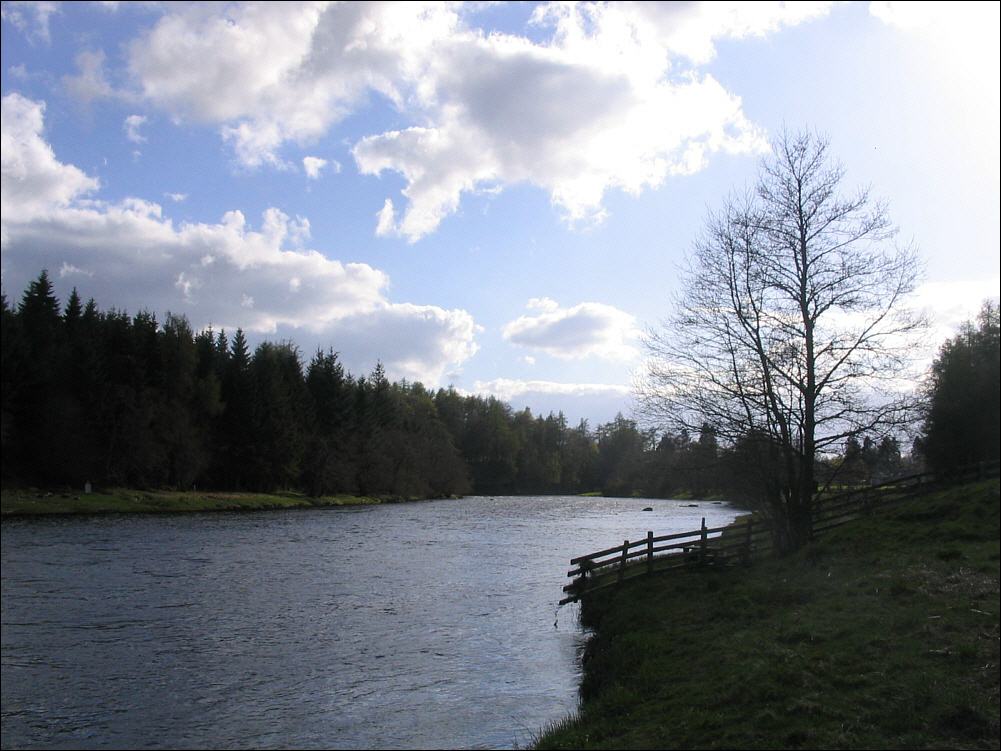
thrawn stupidity? More recently, on the Spey, on
exploring a new section of river, I came upon the most
perfect looking piece of sea trout water, near the upper
limit of the Grantown Association water. I wondered why
I had not discovered it before but resolved to rectify
my omission that very night. I arrived early, in great
anticipation, and was amazed to have a whole quarter
mile of perfect sea trout water to myself, the jewel of
which was a pool of maybe a hundred yards in length,
with fast water at the head running at a depth of about
five or six feet down the far bank, an easy cast of
twenty yards with the line swinging round in a straight
line at perfect pace all the way to the tail of the
pool, with the bonus of easy wading over shallow gravel
down the left bank..... not something you expect on
association water. I fished carefully down the whole
length and saw only one small sea trout jump in the tail
of the pool.... the pool seemed empty. In conversation
with an experienced visitor to the river, I later found
that this pool rarely produces sea trout. Yet, just a
couple of hundred yards above, on the Abernethy
Association water, lie some of the most productive sea
trout pools on the river (see recent favourite pool
article “The Nethy Pool” in Trout & Salmon magazine). I have learned, usually the
hard way, that not all pools are as productive as they
might look. Location is just about everything in sea
trout fishing. Give me any old fly..... a bit of black
hair tied roughly to a hook … and the ability to read a
sea trout river...... and I’ll be a happy man!
.....
next page
See also:
|