Sea Trout Fishing - Sea Trout Tackle
Essential items of tackle for sea trout night fishing
As we have seen in the earlier articles
in this series, a sea trout rod will, on occasion, be
required to cast fairly large and/or heavy flies. Such
flies cannot be cast easily on a light line. In
addition, our sea trout rod may be called upon to cope
with very strong fish, so it should be a fairly strong
rod. For general sea trout fishing, I would recommend a
rod of ten feet in length, rated for a number 7 or 8
line, and with a through action, as opposed to a tip
action. Such a rod, which bends progressively throughout
its length, will allow the weight of the line to be felt
more easily when casting at night, when we must rely
solely on feeling. For twenty years, I have used a rod
built on a ten and a half foot Bruce and Walker
Multitrout blank, (since shortened at the butt to ten
feet) rated 6/7. I also use a 10 ft Orvis Western, rated
#7. Both of these rods have a smooth, through action.
Most keen sea trout fishers will be
familiar with Hugh Falkus's recommendation of having a
variety of line densities for varying conditions and
times, a floating line for early in the night,
particularly in low water conditions, with the option of
additional lines with different sinking rates for high
water or when the sea trout have "gone down" late in the
night. Indeed, he recommended setting up
two
rods for the night, one with a floating line and the
other with a sinking line, so that he could switch
between the two, fishing a variety of flies and lures -
singles, sunk lures, surface lures - according to
conditions as they changed throughout the night. This is
a good option, particularly if you have a pool or two to
yourself for the night and don’t plan on moving about
too much. Specific requirements will be determined by
the characteristics of the river but, on the rivers I
have fished, I would say that about eighty percent of my
fishing is done with a floating line, a double tapered
line in size seven or eight. An intermediate line or
line with a sink tip is useful when the river is running
slightly high or for later in the night when
temperatures fall. I rarely now use a full sinker,
although I acknowledge that this omission may, on
occasion, cost me the chance of a fish. In general, I
will feel fairly well equipped if I arrive on a sea
trout river with a floating line and an intermediate
line, plus a few sink tips in a variety of lengths and
densities, cut from a few mill end lines. I like the
simple practicality of the double taper. I find it
pleasant to handle, less liable to tangle on bankside
vegetation, and its use allows variable lengths of line
to be lifted from the water and recast with no need for
a false cast. I should say, however, that many
experienced sea trout fishermen prefer weight forward
lines, and the standard choice for many is an
intermediate rather than a floating line.
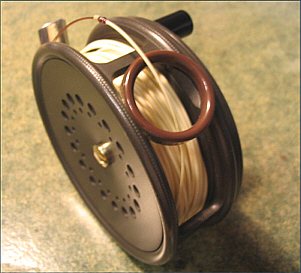
The main requirement of a sea trout reel,
for me, is that it will hold a double tapered seven or
eight floating line and a hundred yards of backing line.
Such a reel is likely to have a diameter of about three
and three quarter inches and a spool width of about one
inch. Excellent examples of such a sea trout reel are to
be found in the Hardy Marquis #10 and the Hardy St
Aidan.
To
enable the faster retrieval of line, many experienced
sea trout fishers prefer a geared "Multiplier" reel,
such as the Hardy Marquis 8/9 multiplier or the Young's
1500 series multiplier or Shakespeare Speedex reel, all
excellent sea trout reels with diameters of about three
and a half inches and with enough capacity to hold a
number eight line. Other reels worthy of consideration
might include the more recent Sharpes Mentieth, which
can be used in silent mode, always useful for those who
prefer the quiet approach. Of course, there is a wide
variety of rods and reels on the market today (* see T&S
review of sea trout rods), many of which will do the job
admirably, if no more efficiently than my ageing
favourites.
In fishing for sea trout at night, we
will often need to wade, sometimes quite deeply. At
other times we will be fishing with steep banks behind.
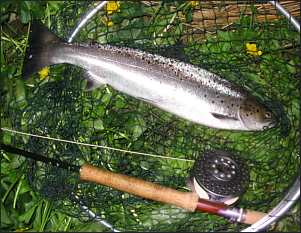
In such circumstances, a net is essential, one that can
be carried comfortably and, when needed, brought into
action quickly and conveniently. It can be a folding net
or one fixed on a handle slung over one’s back, as long
as it can be operated simply and reliably with one hand.
For many years, I have used a Gye net, made by Sharpes
of Aberdeen and have found it excellent.
One final essential item of equipment for
the night fisherman is a good reliable, waterproof
torch. It should be emphasised here that the use of a
torch on the riverbank is generally frowned upon,
particularly if shone directly upon a sea trout pool.
The use of a torch should be kept to an absolute
minimum, used only for essential tasks like retying a
cast or changing a fly. Some night fishermen
can
manage even those operations by touch, without the need
for a torch. When the use of a torch is necessary, it is
best to come ashore and direct the torch beam well away
from the pool being fished. There is a good range of
torches available now which are suitable for night
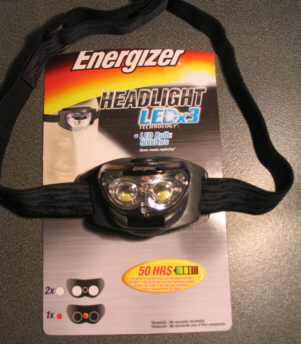
fishing. I have for many years used a small Infinity
Ultra LED torch hung around my neck on a cord. Very
recently, however, I spotted a headlight, an Energiser
Headlight LED X 3, on sale in B&Q for just £7.99, which
I just had to have. On getting it home, I installed the
three AAA batteries supplied and tried it out. A simple
switch gives two options ... a double white LED or a
single red LED. The white light is easily bright enough
to light an unfamiliar path to and from the river, while
the single red light is sufficiently bright to change a
fly, with minimal detriment to night vision. On trying
it out, I found the light very effective, easy to
operate and as comfortable as I imagine most headlights
would be. However, feeling that the light might become
uncomfortable after a few hours fixed on my head,
especially if worn under a hat, I tried it around my
neck ... a bit like an illuminated bow tie ... and found
it very comfortable, providing a perfect light for
changing a fly, with the option of slipping it up and
around the head when walking. With a stated 50 hours of
continuous light between battery changes, this seems
like a very worthwhile purchase.
[You may still be wondering what rivers
would be in my top ten. Well, it is really a wish list,
as I have personal experience of only a few of them,
but, having perused that pile of Trout & Salmon
magazines over a dram or two of fine malt, here they
are. I could easily add another ten.
Spey, Towy, Dovey, Teifi, Border Esk,
Nith, Annan, South Esk, Dee (Aberdeenshire), Wear
Prior to the coming of the salmon farms
to the West Highlands of Scotland, the list would have
been significantly different.]
See also:
|